
The mixer stays in the cabinet for this one, and not as a gimmick. There is nothing in the batter that a stand mixer would do better, and one of the steps it usually performs would actively make this cake worse.
Eight minutes from the first egg to the pan going in the oven, timed on a weeknight with two children asking when it will be ready. One bowl, one fork, one square pan, and a peeler that is the only real work in the whole thing.
The two questions worth answering, because they are the two that go wrong, are how much apple the batter can hold before the middle stops setting, and what the crumb is doing by the third day. Both were settled by baking the same recipe repeatedly with one variable moved.
- Active time: 8 minutes, plus about 6 for peeling
- Bake: 50 to 60 minutes at 350 degrees, 8-inch square pan
- Apple ceiling: 3 cups diced, about two large apples
- Fat: oil, not butter, and the reason is day three
- Doneness: 200 to 205 degrees in the center
- Holds: three days covered at room temperature, better on day two
Eight minutes, a bowl and a fork
The full ingredient list is nine things, and seven of them are already in the cabinet. Two large apples, all-purpose flour, brown sugar, baking powder, baking soda, salt, cinnamon, two eggs, neutral oil and a few spoonfuls of plain yogurt.
The method is the muffin method, which is the one where wet things get whisked together, dry things go in on top, and everything is folded until it just comes together. It is fast because it is forgiving in one direction and unforgiving in the other: undermixing leaves a streak of flour, which you can see and fix, while overmixing builds gluten and produces a tough cake, which you cannot see until it is cut.
What takes real time is the fruit. Two large apples peeled, cored and cut into half-inch pieces is roughly six minutes with a decent peeler and a sharp knife, and there is no shortcut worth having. A food processor turns apples into slush.
What the creaming step was doing, and what replaces it
Creaming butter and sugar is not mixing. It is aeration: the sugar crystals cut into solid butter and drag air pockets in with them, and those pockets become the crumb once the oven expands them. It takes four to six minutes with a machine and it requires butter at exactly the right temperature.
This batter skips all of it and leans on chemistry instead. Baking powder carries an acid and a base in the same tin and produces gas twice, once when it meets liquid and again when it meets heat. The soda handles the acidity coming from the yogurt and the brown sugar, and browns the top a shade darker in the process.
A creamed batter and a chemically leavened one do not taste the same, and it is fair to say which is better at what. Creamed cakes are lighter and finer, with a tighter crumb. This one is denser, moister and coarser, closer to a coffee cake, which is exactly the texture that carries three cups of wet fruit without collapsing. A fine airy crumb and a pound of apples are not compatible.
One practical consequence: once the liquid meets the powder, the clock is running. Get the pan into the oven within about five minutes of combining rather than answering the door first.
Oil instead of butter, and what it costs
Butter is 15 to 18 percent water and solid at room temperature. Oil is neither. That single difference decides how the cake feels on the second and third day, because butter in a cooled crumb sets firm and reads dry, while oil stays liquid and the same crumb still reads moist.
What oil costs is flavor. A butter cake tastes like butter and this one does not, which is why the cinnamon, the brown sugar and the fruit have to do more work. Half a teaspoon of vanilla and a proper amount of salt matter more here than they would in a richer batter.
Any neutral oil works, and light olive oil is good in a fruit cake. Melted butter substitutes one for one if flavor is worth more to you than shelf life, and in that case eat it the first day.
Easy apple cake, from the bowl to the pan
- Heat the oven to 350 degrees. Line an 8-inch square pan with parchment, leaving an overhang on two sides.
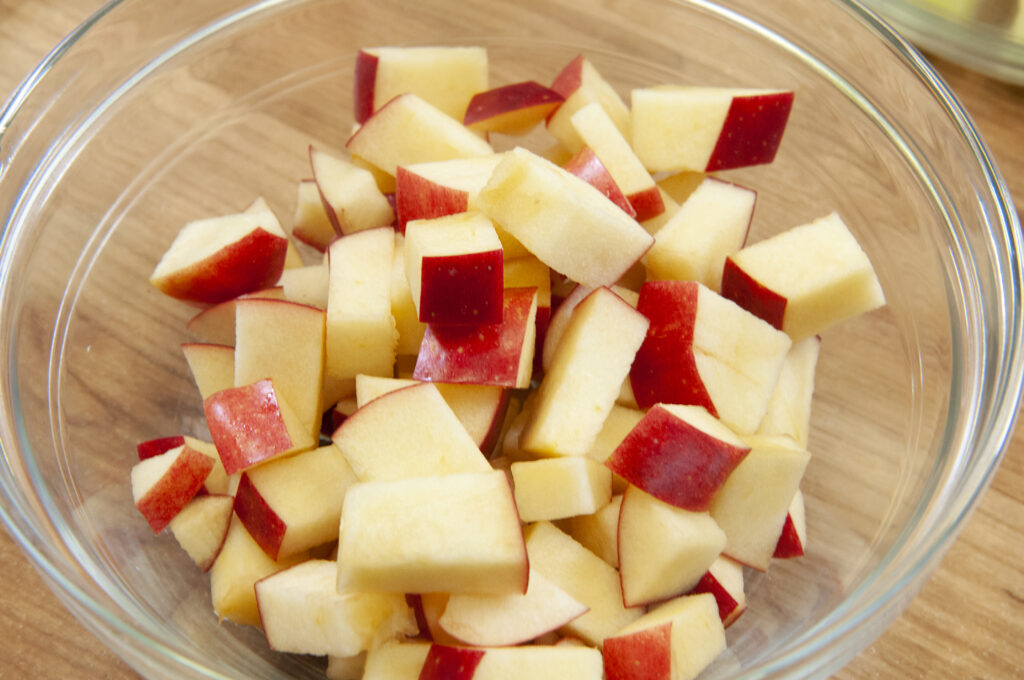
- Peel, core and dice 2 large apples into half-inch pieces. You want about 3 cups. Set them aside.
- In a large bowl, whisk 2 eggs, 1/2 cup neutral oil, 1/3 cup plain yogurt, 1 cup packed light brown sugar and 1 teaspoon vanilla until smooth, about forty seconds with a fork.
- Add 1 1/2 cups all-purpose flour, 1 1/2 teaspoons baking powder, 1/2 teaspoon baking soda, 1 1/4 teaspoons cinnamon and 1/2 teaspoon salt directly on top. Whisk the dry ingredients together on the surface for a few seconds before folding them down.
- Fold with a spatula until no dry flour is visible, then stop. Twelve to fifteen strokes. The batter is thick and will look too stiff. It is not.
- Add the apples and fold four or five more times, just enough to distribute them.
- Scrape into the pan and level the top. Sprinkle with a tablespoon of coarse or turbinado sugar if you want a crackly lid.
- Bake 50 to 60 minutes, tenting loosely with foil at the 40-minute mark if the top is already dark. Cool in the pan at least 30 minutes before lifting it out by the parchment.
How much apple the batter can carry
This was the question worth six bakes. The same batter, the same pan, the same oven, with only the quantity of fruit changing.
| Diced apple | Bake time | Result |
|---|---|---|
| 2 cups | 45 to 50 min | A cake with apple in it. Clean, a little plain |
| 2 1/2 cups | 50 min | Fruit in every bite, crumb still dominant |
| 3 cups | 50 to 60 min | The target. Barely enough batter to hold it together |
| 3 1/2 cups | 65 min | Wet ring an inch in from the edge, sets on cooling if you wait |
| 4 cups | 75 min and counting | A band across the middle that never sets. The edges overbake first |
The reason the ceiling exists is water. Apples are roughly 85 percent water, and that water leaves the fruit during baking and has to go somewhere. Up to about three cups, the flour and eggs can absorb and bind it. Past that, there is more liquid in the pan than there is structure to hold it, and no amount of extra time fixes the problem because the edges are burning while the middle is still steaming.
If you want a fruit-dominant cake, the answer is a wider pan rather than more apple. The same batter with 3 1/2 cups of fruit in a 9-inch square works, because it is shallower and the water has less distance to travel out.
Tossing the diced apple in a tablespoon of the measured flour helps with suspension, so the fruit does not all end up in the bottom third. It is not a fix for going over the ceiling.
Dice size, and the half-inch rule
Half-inch cubes are small enough to cook through in the time the cake takes and large enough to stay recognizable as fruit. It is not a fussy measurement, it is a range: anything from a bit under half an inch to about three-quarters behaves.
Larger chunks, the inch-and-up pieces people cut when they are in a hurry, create pockets. Each one releases its water in a concentrated spot and leaves a wet crater in the crumb around it, and the cake looks fine until it is sliced.
Grated apple makes a different cake entirely, closer to a pudding, and the fruit disappears as a texture. If that is the goal, use two and a half cups grated rather than three, since grating releases more water up front.
Four apples, and how each one behaves at 350
The variety matters more here than in a pie, because there is no sugar syrup or thickener to compensate. What you put in is what you get.
| Apple | Holds shape | Sweetness | In this cake |
|---|---|---|---|
| Granny Smith | Very well | Tart | Distinct pieces, sharp against the brown sugar. The safe pick |
| Honeycrisp | Well | Sweet | Juicy, holds bite, pushes the batter toward its water limit |
| Braeburn | Well | Balanced | The best all-around choice if the store has it |
| Golden Delicious | Softens | Mild and sweet | Melts into the crumb. Pleasant, but you lose the fruit |
| McIntosh | Collapses | Sweet-tart | Becomes sauce. Use as half the total, never all of it |
Mixing two varieties is the honest best answer, and one and a half apples of a firm type with half of a softer one gives you both distinct pieces and a little sauce binding them. There are thousands of cultivars of the domesticated apple and most markets carry six, so this is a decision between whatever two are in front of you.
What to avoid is a mealy apple, whatever its name. An apple that is already soft and grainy raw does not improve with heat, and the pieces disintegrate into something with no texture at all.
Doneness, where the skewer lies and the thermometer does not
A skewer into a cake this wet comes out with something on it almost every time, because there is apple in there and apple stays moist. People read that streak as raw batter and put the pan back for another ten minutes, and that is how a good cake becomes a dry one.
Take the temperature instead. An instant-read thermometer into the center should show 200 to 205 degrees. Below about 195 the starch has not fully set and the middle will sink as it cools. Above 210 it is going dry.
If there is no thermometer, use two other signals together. The cake should have pulled very slightly from the sides of the pan, and the center should spring back when pressed with a fingertip rather than holding the dent. A skewer test is only meaningful if it comes out with wet batter rather than moist crumbs, and the difference is visible: batter is glossy and smooth, crumb is matte and grainy.
Cooling matters as much as the bake. Thirty minutes in the pan lets the structure finish setting, and lifting it out hot cracks it down the middle. After that, cutting it warm is fine and arguably better than fully cooled.
What the top gets, in order of effort
Nothing. A tablespoon of turbinado sugar scattered before baking gives a thin crackly lid and takes four seconds. This is the version that gets made most often.
Cinnamon sugar. Two tablespoons of granulated sugar with half a teaspoon of cinnamon, over the batter before it goes in. It sinks slightly and forms a sweet layer just under the surface.
A streusel. Six tablespoons of flour, a quarter cup of brown sugar and three tablespoons of cold butter rubbed together with your fingers until it looks like gravel. It adds about five minutes to the bake and turns the cake into something you could serve to people who came over on purpose.
Frosting. Not on this one. A dense fruit cake under buttercream is too much of everything, and if you want that combination the crumb needs to be lighter and drier first. Buttercream belongs on a cake built to carry it.
Day one, day two, day three
Day one it is good and slightly loose, particularly if it was cut warm. The apple pieces are distinct and the crumb around them is still finding its final texture.
Day two is the best day. The moisture from the fruit has redistributed evenly through the crumb overnight, the cinnamon has bloomed, and the whole thing reads as one cake rather than as batter with fruit in it. If you are baking for something, bake it the day before.
Day three is still good, with the top gone soft and slightly sticky. Beyond that, the fruit starts to break down and the surface goes tacky enough to be unpleasant. This is a three-day cake and it is not pretending otherwise.
Store it covered at room temperature, cut side down on a board or in a tin, not in the refrigerator, where cold firms the oil and stales the starch faster. It freezes well in individually wrapped slices for about three months.
The batter is not for tasting
Everyone knows about raw eggs. The one that gets forgotten is the flour, which is a raw agricultural product that has not been treated to kill anything, and which has been tied to real outbreaks. A bowl of uncooked cake batter carries both risks at once, and the fact that it is a small taste does not change what is in it.
This matters more here than with most recipes, because a fork-and-bowl batter is exactly the sort a nine-year-old will scrape. Give them the folding job and hand over the spatula after it is rinsed. Once the center reads 200 degrees, both the flour and the egg are cooked.
The other note is the pan. Parchment across the whole base, not just grease, because three cups of fruit means sugar against metal and this cake sticks in a way a plain butter cake does not.
Frequently Asked Questions
Can I make this in a round pan or a loaf pan?
A 9-inch round works with the same timing. A loaf pan does not: it is too deep for this much fruit, and the middle stays wet while the outside overbakes. If a loaf is the only pan available, cut the apple to two cups and expect 65 minutes.
Do I have to use yogurt?
Sour cream, buttermilk or an equal amount of milk with a teaspoon of lemon juice all work. Plain milk alone works too, but the soda then has no acid to react with, so add a quarter teaspoon more baking powder and expect a slightly paler top.
Why did my apples all sink to the bottom?
The batter was too loose, usually from measuring flour by scooping the cup into the bag and packing it, which under-delivers rather than over. Spoon the flour into the cup and level it, and toss the fruit in a spoonful of that flour before it goes in.
Can I reduce the sugar?
Down to three-quarters of a cup without much consequence beyond a slightly drier crumb and a paler top, since brown sugar holds water as well as sweetening. Below that the texture changes noticeably, and tart apples will start to dominate.
Is it worth peeling if the apples are organic?
Yes, and it has nothing to do with what is on the skin. At this ratio the peels stay chewy and separate from the softened flesh during baking, and they are the first thing anyone comments on.
Can I double it for a crowd?
Double into a 9 by 13 pan, same temperature, 55 to 65 minutes, and start checking the center temperature at 50. For more of the same kind of baking, our roundup of cakes for a crowd covers the pan sizes.
Bake it once with three cups of apple and a thermometer in hand. If your baking routinely comes out flatter or drier than promised, the culprits are usually measurement and oven temperature rather than the recipe.