
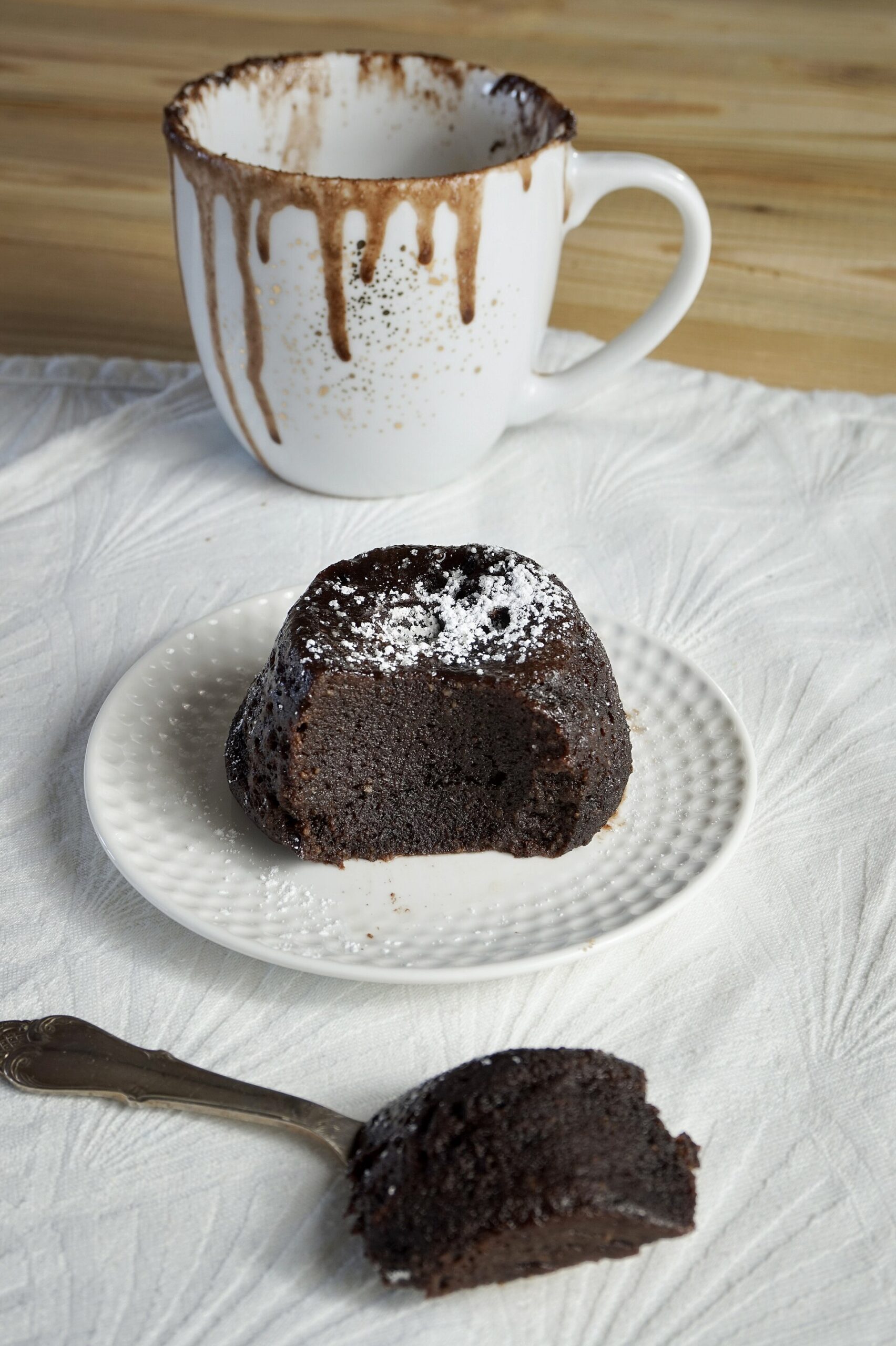
The dome rises at about fifty seconds. It keeps rising, presses against the rim, and looks finished. Then the machine runs another forty seconds because the recipe said ninety, and what comes out is a dense puck with a dry ring at the top and a bounce like a pencil eraser.
Nothing was wrong with the ingredients. The cake was done at fifty seconds and cooked for forty more, which in a microwave is a very long time. A conventional oven gives you a five-minute window on a cupcake. A mug cake at full power has a window of roughly fifteen seconds.
Fixing it takes three changes: less flour, less power, and a rest on the counter that finishes the cooking without any additional heat. The recipe underneath is almost the same one you already have.
- The error: full power, and a time set by the recipe instead of by the batter
- Flour ceiling: 4 tablespoons per mug, and 3 is better
- Power: 50 percent, which roughly doubles the time and widens the window
- Doneness: the top looks barely damp and stops rising
- Rest: 2 minutes on the counter before a spoon goes in
- Mug: straight-sided, at least 12 ounces, filled no more than halfway
What the microwave is actually doing to the batter
A microwave oven heats by agitating water molecules throughout the food at once. There is no hot surface, no browning, and no gentle gradient from the outside in. The whole mug climbs toward the boiling point of water together, and it gets there fast.
That has two consequences a baker notices immediately. There is no crust, because crust requires a dry surface above 300 degrees and nothing in a mug ever gets there. And there is no coasting period; an oven cake spends its last four minutes drifting toward done, while a mug cake goes from wet to set to overcooked in the time it takes to read this sentence.
The steam is the other half of it. Water inside the batter turns to vapor, that vapor inflates the cake, and once the structure has set the vapor keeps leaving. Every extra second of running time is moisture walking out of the mug, and the dryness people blame on the recipe is almost always the last twenty seconds.
The rubber comes from three things at once
Overcooked egg protein. A whole egg in a single-serving cake is a lot of egg. Egg proteins set, then tighten, then squeeze out the water they were holding, and a tightened egg protein network is exactly what a rubbery texture is.
Too much flour, worked too hard. Six tablespoons of flour stirred vigorously in a narrow mug develops more gluten than the same batter spread across a cupcake pan, because the mug forces the spoon to work in a small circle. Gluten is what makes bread chewy and what makes cake tough.
Not enough fat. Fat coats flour proteins and physically blocks some gluten formation, and it also holds moisture as the cake cools. Mug cake recipes are often written with a single tablespoon of oil to keep the dish honest, and that is under the amount needed for a tender crumb.
All three compound. Reducing flour by two tablespoons and adding one of oil changes the texture more than any adjustment to the cooking time, and the cooking time change on top of that is what makes it reliable. The same three levers run the structure of a full-sized cake, only slower and with more room for error.
The ratio, and the ceiling on flour
The workable base for a 12-ounce mug is four tablespoons of flour, three of sugar, three of milk, two of melted butter or neutral oil, a quarter teaspoon of baking powder, and a pinch of salt. No egg.
Three tablespoons of flour makes something closer to a pudding cake, and many people prefer it. Five is where the batter starts to read like paste and the cake goes heavy. Six is the number in most recipes on the internet and it is too many for a mug this size.
Liquid should be roughly three-quarters of the flour by volume, so four tablespoons of flour wants three of milk. Any thinner and the batter climbs over the rim; any thicker and there is not enough water to generate the steam that lifts it.
Sugar is not only sweetness here. It is hygroscopic, which means it holds water in the crumb, and cutting it to a single tablespoon to make the cake healthier produces something noticeably drier and tougher. If the goal is less sugar, make a smaller cake rather than a leaner one.
The microwave mug cake, minute by minute
- Melt two tablespoons of butter in the mug first, about twenty seconds, and swirl it up the sides. That is the greasing step and it costs nothing extra.
- Add three tablespoons of sugar and three of milk to the melted butter and stir until it looks uniform. Wet ingredients first means fewer strokes later.
- Add four tablespoons of all-purpose flour, a quarter teaspoon of baking powder and a pinch of salt on top.
- Stir with a fork for about twenty seconds, until the last dry streak disappears and no further. Lumps the size of a grain of rice are fine. Beating it smooth is how the gluten gets built.
- Scrape the sides down and check the fill line. The batter should sit no higher than the halfway point of the mug, because it roughly doubles before it settles.
- Microwave at 50 percent power for 90 seconds. Stop and look. If the surface still has a wet, shiny pool in the center, give it 15 seconds more, then check again.
- Pull it when the top looks matte and barely damp and the cake has stopped climbing. A toothpick should come out with a few moist crumbs, not clean. Clean means it is already overcooked.
- Rest two minutes on the counter before eating. The mug is holding a great deal of heat and the middle finishes during that rest.
Fifty percent power, and the times for your wattage
Most countertop microwaves do not reduce their output when you select a lower power level. They cycle the magnetron on and off, running at full strength for part of each interval and coasting for the rest. At 50 percent the machine is off roughly half the time.
Those off periods are the reason it works. Heat spreads from the hot spots into the cooler batter while nothing is being added, so the mug cooks more evenly and the gap between the edge and the center shrinks. The trade is time: a cake that runs 60 seconds at full power runs about 100 to 120 at half, and the window of acceptable doneness stretches from roughly fifteen seconds to nearly a minute.
Wattage varies enough that a single number in a recipe cannot work. The label inside the door usually gives it. If not, heat one cup of cold tap water on high and time how long it takes to boil: about two minutes suggests a strong 1100-watt machine, three minutes points to something near 700.
| Wattage | At 50 percent power | At full power | Check at |
|---|---|---|---|
| 1200 W | 80 to 95 seconds | 45 seconds | 70 seconds |
| 1000 W | 95 to 110 seconds | 55 seconds | 85 seconds |
| 900 W | 105 to 125 seconds | 60 seconds | 95 seconds |
| 700 W | 135 to 160 seconds | 80 seconds | 120 seconds |
Write the number that worked on a sticky note inside a cabinet door. Mug size, mug material and batter temperature all shift it slightly, but once your kitchen has a figure, the guessing stops permanently.
The two-minute rest that finishes the cooking
A ceramic mug holds serious heat, and the batter at the center of it is still climbing in temperature after the machine stops. That is carryover, and it is the same effect that makes a roast rise several degrees off the heat.
Which means the correct pull point is slightly underdone. A cake that looks perfect the instant the door opens will be dry by the time it is cool enough to eat. A cake with a faintly damp top and a center that still looks soft is the one that comes out right two minutes later.
Two minutes is also about how long the mug takes to become safe to hold. Ceramic straight out of a microwave can be hot enough to burn, and the steam released when a spoon breaks the surface comes out fast. Both are worth knowing before handing one to a child.
The mug decides more than the recipe does

Width beats height. A wide, straight-sided 12-ounce mug cooks evenly because no part of the batter is far from a surface. A tall narrow one leaves a raw core under a set top, which reads as underbaked and gets another thirty seconds, which then overcooks everything above it.
Volume matters as much. An 8-ounce mug filled to the halfway point holds too little batter to make a satisfying cake, and filled higher it climbs over the rim and welds itself to the turntable. Twelve to sixteen ounces is the useful range.
Ceramic and standard glass both work. Skip anything with a metallic rim, gold lettering or a painted glaze of unknown origin, since metallic decoration arcs and old glazes are not always food-safe at heat. Thin porcelain heats faster than heavy stoneware, so a heavy mug adds about ten seconds.
Egg, no egg, and the raw flour question
The eggless version above is not a compromise, it is the better cake at this size. A whole egg is too much protein for four tablespoons of flour and it is the fastest route to rubber. If you want the richness, use one yolk and drop the milk to two tablespoons.
That choice has a safety side. A yolk in a cake this small can end up short of a temperature that deals with salmonella, especially if the cake is pulled early, so if anyone eating it is pregnant, very young, elderly or immunocompromised, make it without egg. The eggless version has no such issue at all.
Raw flour is the risk people never think about. Flour is a raw agricultural product and has been tied to real outbreaks of E. coli and salmonella, which is why licking the spoon is genuinely not a good idea, and why the batter should not sit around being tasted. If you want to eat something raw and flour-based, heat-treat the flour first: spread it on a sheet pan at 350 degrees until it reaches 165 degrees at the center, then cool it before using.
Five variations that hold the ratio
Each of these keeps four tablespoons of flour and three of liquid, so the timing above does not change.
- Chocolate: swap one tablespoon of the flour for cocoa powder and add an extra teaspoon of sugar, since cocoa is bitter
- Peanut butter: stir one tablespoon into the melted butter and reduce the added fat by half
- Lemon: replace one tablespoon of the milk with lemon juice and add the zest; the acid tenderizes the crumb noticeably
- Apple cinnamon: a quarter teaspoon of cinnamon and two tablespoons of finely diced apple, which adds water, so add ten seconds
- Confetti: a teaspoon of sprinkles folded in at the very end, not stirred, or the color bleeds gray
Anything wet counts against the liquid column. Mashed banana, yogurt and jam all bring water, so remove a tablespoon of milk for every tablespoon of them you add or the cake turns gummy at the bottom. A spoonful of warm ganache poured into a well in the center after the rest is the one addition that breaks no rules, because it goes on after the cooking is finished.
Handing the mug to a nine-year-old
This is a good first recipe for a child, mostly because it is short and there is no oven involved. It is also the recipe where children get burned, and the burn comes from the mug rather than the machine.
Set three rules. The mug comes out with a folded towel, not bare fingers. Nothing gets tasted until the two-minute rest is over. And the spoon goes in from the side rather than straight down the middle, since trapped steam escapes in one push.
The batter is the other line. A quick stir with a fork is the job; running a finger around the bowl is not, because of the raw flour. Children old enough to work the keypad are old enough to understand that rule if it is explained rather than announced.
What one mug cake is worth, roughly
Made as written with butter and whole milk, the whole mug lands somewhere around 400 to 480 calories, with most of it split between the butter and the sugar. That is an estimate rather than a measurement, and it swings with mug size and how heavy the tablespoons were.
The easiest reduction is the fat, but it is also the one that costs the most texture. Dropping to one tablespoon of butter takes off roughly a hundred calories and produces a distinctly drier cake, which is a trade rather than an improvement. Cutting the sugar by one tablespoon costs about fifty and is less noticeable.
This is dessert in a mug, sized for one person and made in three minutes. What it does well is stop a craving at nine at night without leaving a full pan behind, which is its real advantage over the fast oven desserts.
Frequently Asked Questions
Why did my cake overflow the mug?
Too much batter, too much baking powder, or both. Fill no higher than halfway and keep the leavening at a quarter teaspoon. A cake that climbs over the rim loses the structure holding it up and collapses into a dense ring.
Can I make the batter ahead and cook it later?
Not usefully. Baking powder starts reacting the moment it meets liquid, and most of the lift is spent within about fifteen minutes. Dry-mix jars are a better version of the same idea: flour, sugar, baking powder and salt premeasured, with the wet ingredients added at the last minute.
Why is the bottom wet and the top dry?
Almost always a narrow mug. Heat reaches the center of a tall column of batter slowly, so the top sets and dries while the bottom is still liquid. Switch to a wider mug before changing anything else in the recipe.
My microwave has no power settings. What now?
Run it in bursts on full power: 20 seconds, 15 seconds, 15 seconds, with ten seconds of rest between each. The pauses do what a lower power level does, and stopping between bursts also forces you to actually look at the cake.
Is the toothpick test reliable here?
Only if you read it differently than for an oven cake. Clean means overcooked in a mug. A few moist crumbs clinging to the toothpick is the target, and the surface should still look faintly damp when it comes out.
Can this be made without dairy?
Yes. Oat or soy milk works one for one, and neutral oil replaces butter at the same volume. Oil versions stay soft longer, since butter firms as it cools and oil does not.
Run one cake at 50 percent power tonight and check it fifteen seconds early. If it comes out damp in the middle, that is the correct starting point, and the rest is just writing your machine’s number on a note.