
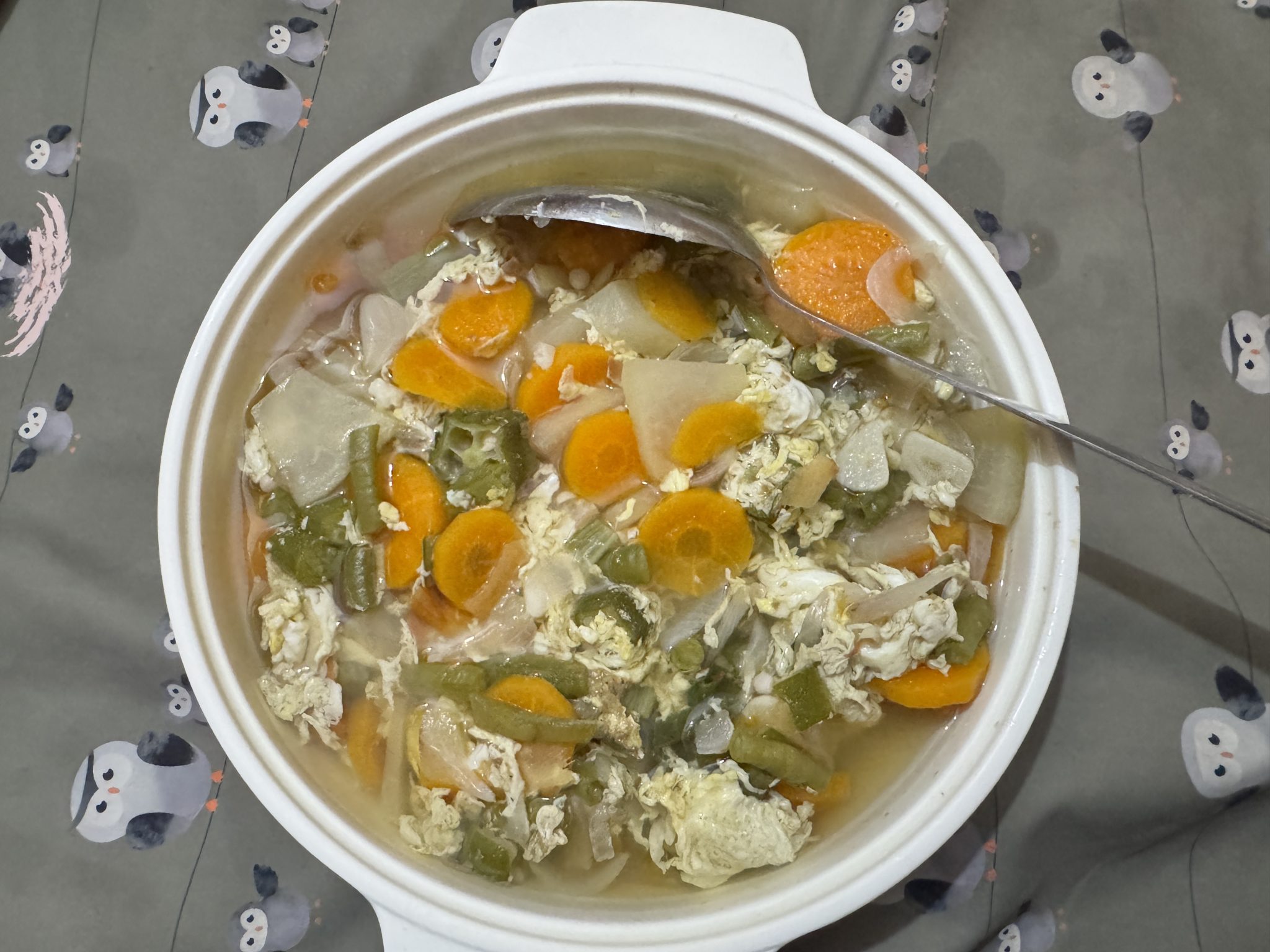
Nine minutes on the stopwatch, and seven of them are spent waiting for a quart of broth to come up to temperature. The part everybody is nervous about, the egg, is over in about twenty seconds.
What separates the bowl that comes out in long silky ribbons from the bowl that comes out as gray scrambled crumbs is not knife skill or years at a wok. It is three things you can measure: how thick the broth is, how hot it is, and how far above the pot your hand is when the egg goes in.
Miss one and the failure is immediately visible, which is at least honest feedback. Hit all three and this becomes a soup you can make on a Tuesday without reading anything.
- Active time: 9 minutes for four bowls, most of it waiting
- Broth: 4 cups, thickened with 1 tablespoon cornstarch
- Eggs: 2 whole eggs, beaten completely smooth
- The pour: a thin stream from roughly 12 inches up
- The heat: a bare simmer, never a rolling boil
- The one mistake: stirring the pot while the egg is going in
What is actually in the pot before the egg goes in
There are five things in this soup, so the broth is not a background ingredient. It is most of the flavor. A boxed low-sodium chicken broth is fine and is what gets used here, but it needs ten cents of help before it earns a bowl.
Two coins of fresh ginger and the white parts of two scallions, dropped into the cold broth and brought up slowly, cover it. By the time the pot is hot the broth tastes like something that was made rather than opened. Fish the ginger out before the starch goes in or someone gets a mouthful of it.
The classic version of this soup is a Chinese restaurant standard built on exactly this economy: stock, starch, egg, and a couple of aromatics. Nothing in it is expensive, which is why every part of the technique matters more than usual.
Salt goes in later. A broth that tastes correct before it is thickened will taste slightly over-salted once the starch concentrates it and the volume drops.
The slurry, and why it goes in cold
One tablespoon of cornstarch to two tablespoons of cold water, stirred with a fork until there is no grit at the bottom of the cup. That is the whole slurry, and it thickens four cups of broth to the consistency you want here, which is not gravy. It should coat a spoon faintly and then run off.
Cold water is not a preference. Dry cornstarch dropped into hot liquid gelatinizes on the outside of each clump instantly and seals the dry powder inside, which is where lumps come from. Dispersed in cold water first, the granules stay separate until they hit the heat all at once.
Stir the cup again immediately before it goes in the pot. Cornstarch falls out of suspension in under a minute, and a slurry that has been sitting on the counter through two other steps is mostly water on top and a white puck underneath.
The broth then needs to come back to a full bubble for about thirty seconds. Starch that has not been brought to a boil thickens partially and leaves a chalky taste. This is the same move that carries a hot and sour soup, only that pot uses roughly double the starch for a much heavier body.
Easy egg drop soup in about nine minutes
- Put 4 cups of low-sodium chicken broth in a saucepan with two coins of ginger and the white parts of two scallions. Medium heat, lid on, roughly five minutes.
- While it heats, crack 2 eggs into a measuring cup with a spout and beat them with a fork for a full thirty seconds, until the color is uniform and no ropes of white are left.
- In a small cup, stir 1 tablespoon cornstarch into 2 tablespoons cold water.
- When the broth is bubbling steadily, remove the ginger. Stir the slurry once more and pour it in while stirring the pot. Let it bubble thirty seconds, then turn the heat down.
- Wait until the surface goes still and only a few bubbles break at the edge of the pan. This is the window, and it lasts a couple of minutes.
- Stir the broth in one slow circle to get it moving, then stop and lift the spout about a foot above the pot.
- Pour the egg in a thin steady stream, moving your hand slowly across the surface. Do not stir. Count to fifteen.
- Season with salt, a pinch of white pepper and half a teaspoon of toasted sesame oil. Scatter the sliced green tops of the scallions and serve straight away.
Pour height, measured against the pot
Height controls how thin the stream is by the time it lands. Egg falling twelve inches has stretched and narrowed on the way down, so it meets the broth as a thread and sets as a thread. Egg poured from an inch above the surface arrives as a blob and sets as a blob.
The other half is the size of the opening. A measuring cup with a proper spout gives a stream about the thickness of a pencil lead. A wide bowl dumps.
| Pour | What it looks like going in | What you get |
|---|---|---|
| Straight from the bowl, low | A single slug of egg | Two or three thick curds, rubbery in the middle |
| 2 to 3 inches, spouted cup | A thick wobbling stream | Short fat ribbons, closer to scrambled |
| 10 to 14 inches, spouted cup | A thread, barely visible | Long silky ribbons, the target |
| 10 to 14 inches, through a fork | Several fine threads at once | Very fine wisps, delicate, restaurant style |
| Any height, while stirring hard | Egg disappearing on contact | Cloudy broth and yellow flecks |
The fork trick in the fourth row is worth one try. Hold a fork over the pot and pour the egg through the tines. It splits the stream into four and produces wisps thin enough to be almost translucent.
The temperature window where ribbons happen
Egg white starts to firm up somewhere around 145 degrees and is fully set by roughly 160. Broth at a bare simmer sits near 185, which is hot enough to set the egg on contact but calm enough to leave the ribbon in one piece.
A rolling boil does two things wrong at once. The turbulence tears the stream apart before it can set, and the extra heat overcooks the protein into something squeaky. If the pot is boiling when you get to the egg, pull it off the burner for thirty seconds and let it settle.
Too cool is the opposite failure and the more common one in a home kitchen, because people are afraid of the boil and overcorrect. Below about 160 the egg disperses into the liquid before it can coagulate, and you end up with a broth that looks like dishwater and has no ribbons in it at all. The general behavior of egg protein under heat is the same here as it is in a custard: the useful range is narrow and the penalty on both sides is texture.
The visual cue is more reliable than a thermometer for this. You want a surface that is still, with small bubbles rising only at the edge where the pan meets the burner.
Stir once, and not while you are pouring
Set the broth turning in a slow circle before the egg goes in, then take the spoon out. A gentle current carries the ribbons apart from one another so they do not weld into a sheet. Ongoing agitation shreds them.
After the egg is in, count fifteen seconds before touching anything. The ribbons need that time undisturbed to set from the outside in. Stir at second three and you will get the flecks.
One slow stir at the end lifts everything off the bottom of the pot and distributes it. That is the last time a spoon needs to go in before the ladle.
Two eggs, three eggs, and what an extra yolk does
Two whole eggs into four cups of broth is the balance most people want: visible ribbons in every spoonful with broth still reading as broth. Three eggs pushes it toward a thicker, more filling bowl and starts to mute the ginger.
An extra yolk on its own, beaten into the two whole eggs, is the one adjustment worth knowing. It deepens the color to something closer to marigold and makes the ribbons noticeably softer, because yolk fat interferes with the protein network that makes egg white firm.
Beating matters more than the count. Thirty seconds with a fork, until there are no clear streaks of white left, produces uniform ribbons. An underbeaten egg drops in as two separate materials and sets as two separate textures, with pale rubbery bits alongside yellow ones.
Room temperature eggs disperse marginally better than cold ones, though the difference is small enough that nobody should wait for it. If they are going in straight from the refrigerator, beat them a few seconds longer.
Two additions that make it dinner
As written this is a starter, and about 90 calories a bowl. Two things turn it into a meal without touching the technique.
Silken tofu. Half a block, cut into half-inch cubes, slid in right after the slurry and left alone. It needs two minutes to heat through and it will break if you stir it, so add it before the egg and never after. It brings the bowl to something like 14 grams of protein and costs almost nothing.
Shredded chicken. A cup of meat pulled off a rotisserie bird, added at the same point as the tofu purely to warm through. Chicken that is simmered for any length of time in a thin broth goes stringy, so treat it as a garnish that happens to be hot rather than an ingredient that cooks.
A third option, if the goal is volume rather than protein, is a nest of thin noodles cooked separately and put in the bowl before the soup is ladled over. Cook them in their own water, not in the broth, or the starch they shed will thicken the pot past the point you set it at. The same rule applies to any quick noodle bowl built on a clear broth.
Frozen corn and frozen peas both work, go in with the slurry, and are the cheapest way to make the bowl look like more than it is.
Seasoning goes in after the egg
White pepper is the flavor most people cannot name in the restaurant version. It is earthier and more floral than black, and a quarter teaspoon in four cups is enough to notice. Black pepper is a fine substitute and makes a visibly different soup.
Toasted sesame oil goes in off the heat, half a teaspoon for the pot. It is a finishing oil and it turns bitter and flat if it boils. Same for the green scallion tops, which go in the bowl rather than the pan.
Salt last, tasted from a spoon that has cooled for a few seconds. Hot liquid reads less salty than it is, and a boxed broth that started at low sodium may need close to a teaspoon or none at all depending on the brand.
Scaling for four, and for one
Everything scales cleanly except the pot. The stream of egg is the same thickness whether the pan holds one cup or six, so a small batch in a small saucepan gives you less surface to spread it across and a denser result.
| Servings | Broth | Cornstarch | Eggs | Pan |
|---|---|---|---|---|
| 1 | 1 1/4 cups | 1 teaspoon | 1 | Small saucepan, 6 inch |
| 2 | 2 cups | 1 1/2 teaspoons | 1 | 2 quart |
| 4 | 4 cups | 1 tablespoon | 2 | 3 quart |
| 6 | 6 cups | 1 1/2 tablespoons | 3 | 5 quart, wide |
For a single serving, use the fork trick rather than a plain pour. Fine wisps distribute better through a cup and a quarter of broth than three fat ribbons do.
Leftovers, and the ribbons that change overnight
This soup is at its best within about ten minutes of the egg going in. Refrigerated overnight, the ribbons firm up and go slightly spongy, and the cornstarch loosens its grip so the broth thins out. It is still good. It is not the same thing.
Get it into a shallow container and into the refrigerator within two hours of cooking, and inside one hour if the kitchen is warm. Depth is what matters for cooling speed: a quart in a wide container drops through the risky temperature range far faster than the same quart in a tall one. Eat it within three to four days and reheat it to steaming rather than merely warm.
Do not freeze it. Cooked egg white loses its water on thawing and comes back tough and weepy, and the starch separates.
One note on the egg itself. The ribbons should be opaque and firm before the bowl goes to the table, with no liquid egg streaking the broth, which is the case any time the pot is at a real simmer when the egg goes in. Anyone cooking for someone pregnant, very young, elderly or immunocompromised should hold the pot at a simmer for a full minute after the pour rather than the fifteen seconds, since the guidance for egg dishes is a fully set 160 degrees.
Frequently Asked Questions
Why is my soup cloudy instead of clear with ribbons?
The broth was too cool, or you stirred while pouring, or both. Cloudiness means the egg dissolved into the liquid before it had a chance to coagulate. Reheat to a bare simmer, and next time wait for the surface to go still before the egg goes in.
Can I use flour instead of cornstarch?
You can, at roughly double the quantity, but the broth turns opaque and slightly pasty rather than glossy. Potato starch and arrowroot are closer substitutes at the same measure. Arrowroot gives the clearest result and does not hold up to long reheating.
Do I have to thicken it at all?
No, and unthickened versions exist. The starch is doing a specific job here though: it slows the broth enough that the egg has time to set in place instead of drifting apart. Skip it and expect finer, more scattered strands.
Can this be made with vegetable broth?
Yes, and it needs more help. Vegetable broths are thinner in flavor and often sweeter, so add a teaspoon of soy sauce and an extra coin of ginger, and be more careful with salt.
My eggs sank to the bottom in one lump. What happened?
They went in all at once from close range. Use a cup with a spout, get your hand a foot above the pot, and pour slowly enough that the stream stays thin the whole way down.
Is white pepper worth buying for this?
If you make Chinese soups more than twice a year, yes. It is the difference between a bowl that tastes homemade and one that tastes like the restaurant, and a small jar lasts a long time.
Make it once at four cups with two eggs before adjusting anything. The pour is a physical skill and it takes one repetition, not ten.