
Hand someone a cookie with a tablespoon of white miso in the dough and ask what is in it. The answers come back as browned butter, or toffee, or too much vanilla, or good salt. Almost nobody says soybeans, and nobody at all says soup.
That gap is the whole reason the ingredient has moved from restaurant pastry sections into ordinary home baking over the last several years. A pale, sweet miso does not taste of itself in a sugar-heavy dough. It reads as the caramelized, slightly salty depth that bakers normally chase with browned butter and flaky salt, and it costs about forty cents a batch.
What follows is the practical version: which tub does this, how much goes in, where in the method it belongs, and the three desserts where the effect is worth the trouble.
- Which one: white miso, sometimes labelled shiro, the pale one
- Per batch of cookies: 1 to 2 tablespoons, replacing the salt
- Where it goes: creamed with the butter, never stirred into flour
- What to cut: the added salt, entirely
- Sodium: roughly 500 to 700 milligrams per tablespoon
- Keeps: about a year in the refrigerator, open
Why a fermented soybean paste tastes like caramel
Miso is soybeans, salt and a grain inoculated with a culture, left to ferment for anything from a few weeks to several years. During that time the culture breaks starches into simple sugars and proteins into free amino acids, and those two products then react with each other slowly at ambient temperature.
That reaction is the same browning chemistry that happens in a hot pan, running at room temperature over months instead of minutes. It produces the brown pigments and the roasted, malty aroma compounds that a baker recognizes immediately, because they are the same family of compounds that make toffee and browned butter smell the way they do.
On top of that sits a large quantity of free glutamate, which is what registers as savory depth on the tongue. In a savory dish that reads as meatiness. In a sugar-dominant dough it has nothing meaty to attach to, so it presents as richness and length instead, and the salt that comes with it does the rest.
Which miso to buy for this
| Type | Ferment time | Salt level | In a dessert |
|---|---|---|---|
| White, shiro | Weeks to a few months | Lowest | The one to buy. Sweet, mild, caramel-leaning |
| Yellow, shinshu | Several months | Moderate | Workable, use two thirds as much |
| Mixed, awase | Blend | Moderate | Unpredictable, depends on the blend |
| Red, aka | A year or more | High | Too assertive except in dark chocolate |
| Barley, mugi | Varies | Moderate | Good flavor, contains gluten |
| Chickpea miso | Varies | Moderate | Soy free, milder, slightly grassy |
The pale tub is the one. It has the highest proportion of rice culture to soybean, which is why it is sweeter and lighter, and the shortest ferment, which keeps the flavor from going meaty. In a supermarket it is usually in the refrigerated case near the tofu rather than in the dry aisle.
A smooth paste beats a chunky one for baking, because visible pieces of soybean do not dissolve into a batter and show up as flecks. If the only tub available is coarse, press it through a fine sieve or blend it with the recipe’s liquid before it goes in.
How much to use per batch
| Dessert | White miso | Adjust |
|---|---|---|
| Chocolate chip cookies, 2 cups flour | 1 to 2 Tbsp | Remove all added salt |
| Caramel or butterscotch sauce | 1 Tbsp per cup of sugar | Remove the salt, add off the heat |
| Banana or pumpkin loaf | 1 Tbsp | Remove the salt, whisk into the wet |
| Ice cream base, 1 quart | 1 Tbsp | Dissolve in the warm base |
| Brownies, 8 inch pan | 1 Tbsp | Whisk into the melted butter |
| Shortbread, 1 cup butter | 1 Tbsp | Cream with the butter, cut sugar slightly |
| Frosting, 2 cups sugar | 2 tsp | Start low, it is very noticeable |
One tablespoon is the dose that registers as depth without announcing itself. Two tablespoons in a cookie dough is the point where a few people start to identify something fermented, which some bakers want and others do not. Three is too far in almost every application.
Scale by the fat rather than by the flour. Miso disperses into butter and oil and stays trapped there, so a rich dough carries more of it comfortably than a lean one. A low-fat batter with the same tablespoon in it tastes patchy, with salty pockets.
Where it goes in the method
Into the fat, always. Cream white miso with softened butter and sugar at the start, exactly as if it were part of the butter, and give it a full two minutes so the paste breaks up completely. For a melted-butter recipe, whisk it into the warm butter before anything else joins.
Stirring it into flour is the common mistake and it produces exactly the result people complain about: small salty lumps and a faint bean flavor in isolated bites. Miso is a wet paste with a high salt concentration, and dry flour will not disperse it.
For a liquid application like an ice cream base or a caramel, whisk the miso into a few tablespoons of the warm liquid first to make a slurry, then return that to the pot. Dumping a cold tablespoon into a hot pan leaves undissolved specks that never go away.
Nothing about adding miso changes the fact that raw dough is not safe to eat. The flour is untreated and the egg is raw, and a savory paste does neither of those things any favors. Bake it, then taste it.
Miso in desserts, and the three sweets where it works best
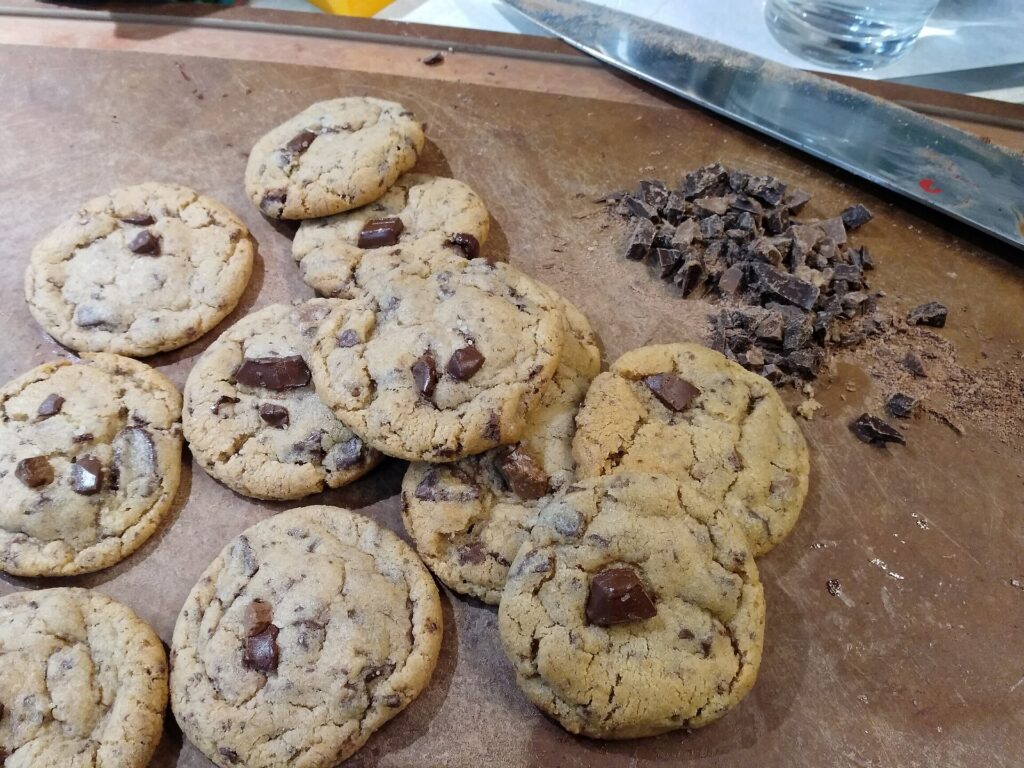
Chocolate chip cookies are the entry point and the strongest case. The dough is already a browned-butter, brown-sugar, salt-forward construction, and miso slots into all three of those roles at once. A batch made with two tablespoons and no other salt tastes like it was made with better butter.
Caramel is the second and arguably the more dramatic. Salted caramel is a balance of burnt sugar, dairy fat and salt, and miso brings a fourth axis that fills the gap in the middle where most home caramels taste thin. Whisk it in off the heat once the cream has gone in, because prolonged boiling flattens the aroma.
The third is anything with banana, dates or brown sugar as the main flavor. Those sweets already lean on slow-cooked sugar notes, and miso extends them. A banana loaf with a tablespoon in it tastes like it sat an extra day, which is what people mean when they say a loaf tastes better on the second morning.
The pattern across all three is that miso amplifies caramelized flavors that are already present rather than adding a new one. That is also the test for whether it belongs in any given recipe, and it is the same test that applies to most savory additions in sweet contexts.
What it does to the salt in the recipe
Remove the added salt entirely and taste before deciding to put any back. A tablespoon of white miso carries somewhere in the region of 500 to 700 milligrams of sodium, which is close to what a half teaspoon of table salt contributes, and that is what most cookie recipes call for.
Doubling both is the single most common failure. A batch made with two tablespoons of miso and the original teaspoon of salt is not subtle and not pleasant, and there is no fixing it after baking. Cut the salt first, bake a test tray, and adjust the next one.
The sodium point matters beyond flavor. Anyone cooking for a household managing blood pressure should count miso as salt rather than as a flavoring, because it is one. In that situation half a tablespoon plus no added salt still gives most of the effect at half the sodium, and the reduced-sodium tubs on the shelf are a legitimate option.
Reading the label before it goes in a cake
Three things on the tub actually matter. The first is the grain: rice miso is gluten free, and barley miso is not, so anyone baking for a celiac household needs to read it rather than assume. Some blended misos include barley without saying so in the name.
The second is the sodium figure per serving, because the range across brands is wide and a tub at the high end will oversalt a batch that was fine with a different one. The third is whether it has been pasteurized. Unpasteurized miso is a live product with active cultures, which matters for a dressing and does not matter at all for a cookie that spends twelve minutes at 350 degrees.
Ingredient lists should be short: soybeans, rice, salt, culture, and possibly alcohol as a preservative. Tubs with added dashi, bonito or sugar syrups exist and are made for soup, and the dashi ones will make a dessert taste distinctly of fish.
Storage, and how long an open tub lasts
An opened tub keeps in the refrigerator for around a year, and often longer. The salt concentration is high enough to hold off spoilage on its own, which is what the product was invented to do in the first place.
It darkens over time, and a pale tub that has gone tan is not spoiled. It has simply carried on fermenting slowly in the cold, which makes it stronger and saltier. Older, darker miso needs to be dosed down in a dessert, by a third or so.
Press a piece of parchment or plastic directly onto the surface before putting the lid back on, which prevents the dry crust that forms at the edges. A white bloom on the surface is usually harmless yeast and can be scraped off; anything fuzzy, colored or sour-smelling goes in the bin.
Freezing works and it does not freeze solid, because of the salt. A tub straight from the freezer is still scoopable, which makes it a reasonable place to keep a large container that will be used a tablespoon at a time. Anyone already keeping cultures and ferments in the house will recognize the storage logic from other fermented projects.
Where it fails
Delicate, pale desserts are the wrong home for it. A lemon tart, an angel food cake, a panna cotta or anything built on fresh fruit and cream has nothing for miso to amplify, so it arrives as a savory note that does not belong and cannot be hidden.
Meringue is the technical failure. Salt and fat both interfere with egg white foam, and miso brings a little of both, so a meringue made with it will not reach volume. The same applies to any recipe that depends on whipped whites for lift.
Red miso in a light dessert is a third failure mode. It is fermented long enough to be genuinely meaty, and in a vanilla or caramel context it reads as broth. If red is the only tub in the house, restrict it to very dark chocolate, where there is enough bitterness to absorb it, and use half the quantity.
Heat, aroma, and the baking temperature question
Most of what miso contributes survives the oven. The glutamates are heat stable, the brown pigments are already formed, and the salt is salt. What does not survive is the top note, the slightly fruity aroma that is obvious when the lid comes off the tub.
That is why applications with less heat exposure taste more distinctly of miso. An ice cream base or an uncooked frosting keeps the aroma, and a cookie baked at 375 degrees keeps only the depth. Neither is wrong; they are different results, and the frosting needs a smaller dose because more of the flavor is intact.
For a cookie specifically, chilling the dough overnight improves the result more than any adjustment to the miso. Time lets the salt distribute evenly through the dough, which is exactly the problem a wet paste creates, and it also does everything else that resting does for a cookie. Bakers who already rest their dough for texture reasons get the miso benefit for free.
Frequently Asked Questions
Will people taste that it is miso?
At one tablespoon in a standard batch, almost never. At two, some people identify something fermented without being able to name it. At three, yes, and it stops being pleasant. Start at one and move up only if the batch tastes flat.
Can I use miso powder instead of the paste?
Yes, and it disperses more easily into dry ingredients, which is its one advantage. Use about a third of the volume, since the water has been removed, and check the sodium on the packet because concentrations vary widely between brands.
Does it work with tahini or peanut butter recipes?
Very well. Both are already savory, fatty and slightly bitter, and miso extends all three. A tahini cookie with a tablespoon in it is one of the better places to start, and the two pastes disperse into each other without any trouble.
Is there a soy-free option?
Chickpea miso is made the same way with chickpeas in place of soybeans and behaves similarly, though it is milder and slightly grassy. Use the same quantity and expect a less pronounced caramel note. It is also worth checking the grain, which is usually rice.
Can I add it to a boxed mix?
Yes, and it is the easiest way to test the idea. Whisk a tablespoon into the oil or melted butter the box calls for, before the eggs and the powder go in, and leave out any salt the instructions mention. Brownie mix is the most forgiving one to try it on.
Why did my caramel taste bitter after adding it?
Almost certainly because it went in while the sugar was still on the heat and boiled. The amino acids in miso brown further at caramel temperatures and tip into bitterness quickly. It goes in at the end, off the heat, once the cream has already gone in.
Buy the smallest pale tub the shop sells and put a tablespoon in the next batch of anything with brown sugar in it. If nobody at the table can name what changed, that is the result the ingredient is for.