
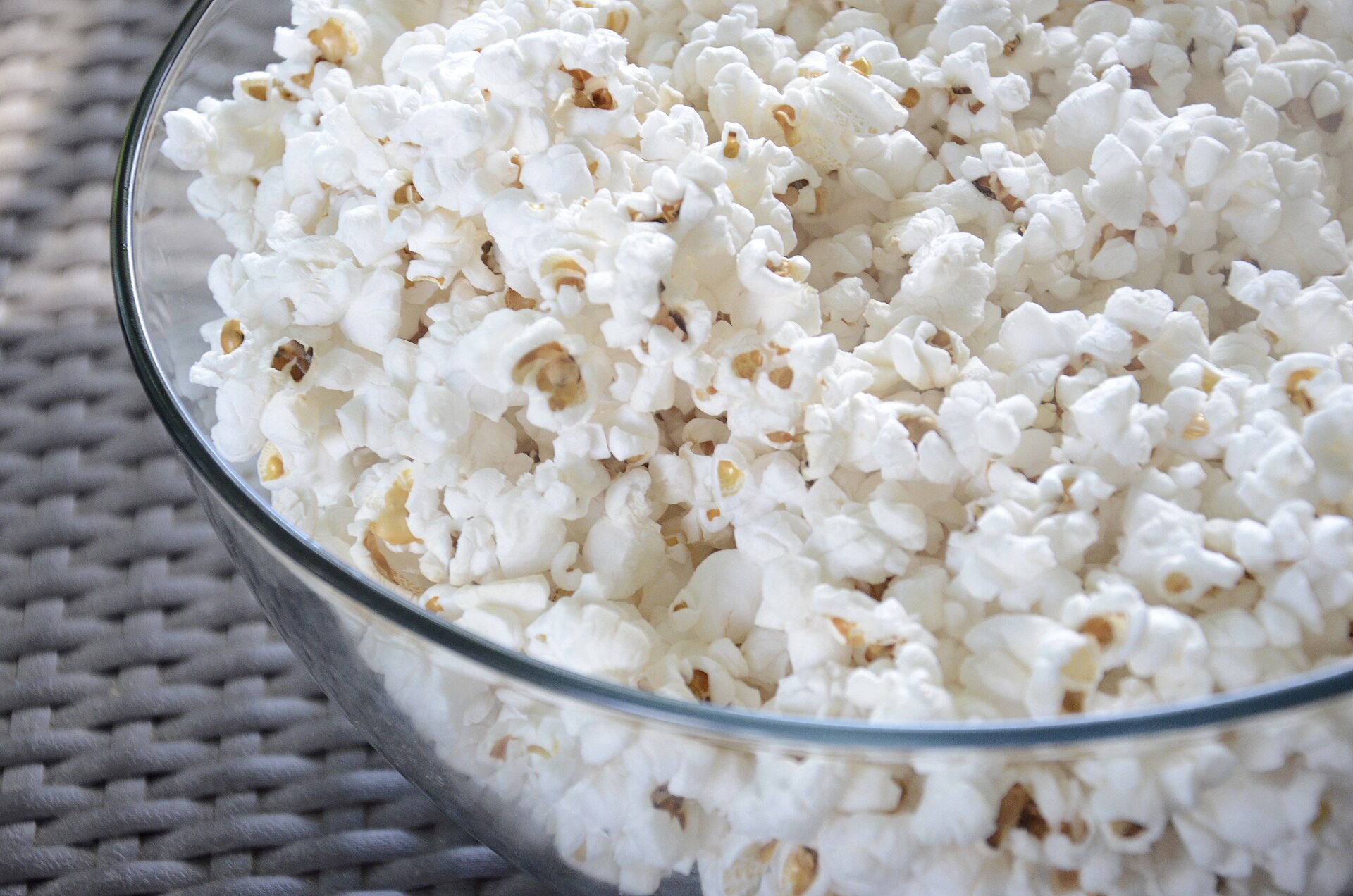
Tip a bowl of home-seasoned popcorn out at the end of a film and there is a small drift of orange or green powder at the bottom, roughly the amount that was measured out in the first place. The popcorn tasted like popcorn. The seasoning tasted like the bottom of the bowl.
The blend was probably fine. What failed is physical: a spice particle only stays on a piece of popcorn if it is small enough for surface tension in a film of oil to hold it, and most jarred spice blends are ground far coarser than that. Anything bigger falls off within about thirty seconds of tossing.
Two adjustments fix it, and neither costs money. Grind the blend finer than it comes, and put down a thin film of oil for it to land in. After that, the ratios below are just flavor choices.
- Batch size: a third of a cup of kernels, about 10 to 12 cups popped
- Grind target: finer than granulated sugar, closer to a dusting powder
- Oil: one to one and a half teaspoons, misted or drizzled
- Salt: fine grain only, half a teaspoon per batch to start
- Per cup, air popped: roughly 30 calories and about a gram of fiber
- What to skip: flaky sea salt, whole seeds, coarse kosher salt
What is actually happening at the bottom of the bowl
A piece of popped corn is mostly air with a rough, irregular surface. Nothing about it is sticky. When seasoning stays on, it is because a very thin layer of fat is bridging the gap between the particle and the surface, and the strength of that bridge falls off sharply as the particle gets heavier.
Weight scales with the cube of diameter. A grain twice as wide is eight times heavier, which is why a coarse grind falls and a fine one clings even though both are made of the same spice. It is not about the spice being good or bad; it is about how it was milled.
Static plays a small part too. A finely ground powder tossed onto warm popcorn distributes far more evenly than the same powder on cold popcorn, because the rising warm air carries it around the bowl before it settles. Seasoning cold popcorn is always patchier.
Particle size, and the number that matters
The useful reference point is table salt. Table salt clings to popcorn and coarse kosher salt does not, and the difference between them is roughly a factor of four in grain width. Anything ground to table salt fineness or below will stay put; anything visibly coarser will not.
Most supermarket spice blends sit somewhere in between. Chili powder and smoked paprika are usually fine enough. Dried herbs, garlic and onion granules, dried citrus zest, sesame seeds, poppy seeds and anything labelled cracked or crushed are not, and those are precisely the ingredients that make an interesting blend.
| Ingredient as sold | Sticks? | What to do |
|---|---|---|
| Fine table salt | Yes | Use as is |
| Flaky or coarse sea salt | No | Grind, or swap for fine |
| Ground paprika, chili, cumin | Yes | Use as is |
| Garlic and onion granules | Marginal | Grind 20 seconds |
| Dried herbs, whole leaf | No | Grind to powder |
| Sesame, poppy, nigella seeds | No | Grind coarsely, accept some loss |
| Nutritional yeast flakes | Marginal | Pulse to a powder |
| Grated hard cheese | Depends | Use the powdery fine side of the grater |
Grinding what you already own
An inexpensive electric coffee grinder kept for spices is the fastest route and takes about twenty seconds per blend. Grind the whole mix together rather than each component separately, which also does the mixing.
A mortar and pestle works and takes two or three minutes of steady effort. Dried herbs and seeds break down readily; hard granules of dried garlic take longer. A small food processor is the least effective option, because the blade passes above most of the powder and the volume is too small for it to circulate.
The low-tech version is a resealable bag and a rolling pin, which is fine for herbs and seeds and hopeless for salt crystals. Grinding produces a lot of airborne dust, so keep the lid on the grinder for a few seconds after it stops before opening it.
One warning worth passing on: never grind a blend that contains dried chili flakes without letting the dust settle, and keep your face away from the open grinder. Ground capsaicin is a genuine irritant in the eyes and airways, and a fresh grind of hot chili in a small kitchen will make that clear within seconds.
The oil mist that carries the seasoning
Air-popped corn is bone dry and holds almost nothing. A teaspoon and a half of oil across ten cups is enough to change that completely, and it adds about forty calories to the whole batch, which is roughly four per cup.
A refillable oil sprayer gives the most even coverage for the least oil. Failing that, drizzle from a spoon while tossing with the other hand, in a bowl big enough that the popcorn actually moves. Pouring oil into a stationary bowl produces four soaked pieces and nine cups of dry ones.
Melted butter works and behaves differently, because it is roughly 16 percent water. That water softens the popcorn within a few minutes, which is why buttered popcorn goes limp and oiled popcorn does not. Clarified butter has the flavor without the water and is worth the two minutes it takes to make.
Neutral oils with a light flavor are the default. Avocado, refined coconut and grapeseed all disappear behind the seasoning. Olive oil is good with the savory blends and assertive enough to notice, and toasted sesame oil is excellent in tiny amounts with the seaweed blend below.
Eight popcorn seasoning recipes, with the exact spoon measures
All eight are sized for one batch, meaning a third of a cup of kernels or about ten to twelve cups popped. Grind each blend before use. Store what is left over in a small jar.
| Blend | What goes in | Notes |
|---|---|---|
| Cheesy yeast | 3 Tbsp nutritional yeast, 1/2 tsp fine salt, 1/2 tsp garlic powder, 1/4 tsp mustard powder | The closest thing to cheese powder without dairy |
| Ranch | 1 Tbsp buttermilk powder, 1 tsp dried dill, 1/2 tsp onion powder, 1/2 tsp garlic powder, 1/2 tsp fine salt | Grind the dill or it falls |
| Chili lime | 2 tsp chili powder, 1 tsp dried lime zest, 1/2 tsp fine salt, 1/4 tsp sugar | The sugar balances the acid |
| Everything bagel | 1 Tbsp sesame seeds, 1 tsp poppy seeds, 1 tsp dried garlic, 1 tsp dried onion, 1/2 tsp fine salt | Must be ground, seeds will not cling whole |
| Curry coconut | 2 tsp mild curry powder, 1 Tbsp coconut milk powder, 1/2 tsp fine salt | The coconut powder softens the spice |
| Cinnamon maple | 2 tsp cinnamon, 1 Tbsp maple sugar, 1/4 tsp fine salt | Maple sugar, not syrup, which makes it soggy |
| Smoky parmesan | 3 Tbsp finely grated parmesan, 1/2 tsp smoked paprika, 1/2 tsp ground black pepper | Use the fine rasp side of the grater |
| Seaweed sesame | 1 Tbsp ground toasted nori, 2 tsp ground sesame, 1 tsp sugar, 1/2 tsp fine salt | A few drops of toasted sesame oil in the mist |
The cheesy yeast blend is the one that surprises people. Nutritional yeast is savory in a way that reads as aged cheese, it carries about two grams of protein per tablespoon, and it is fortified with B vitamins in most brands. Ground to a powder it coats better than any cheese powder sold for the purpose.
The parmesan blend is the outlier because real cheese contains fat and moisture. It sticks well and it also softens the popcorn faster, so that batch should be eaten within twenty minutes rather than kept.
Salt: fine grain, and how much per batch
Half a teaspoon of fine salt across ten cups is a moderate seasoning and a reasonable starting point. A full teaspoon is assertive and still lands well under what a comparable bag of ready-made snack food carries per serving.
Fine grain is not a preference here, it is the requirement. Kosher and flaky salts are prized in cooking precisely because the crystals are large and dissolve slowly, which is exactly the wrong property for a dry surface. If fine salt is not in the house, put kosher salt through the grinder with the rest of the blend.
Salting in two stages is better than salting once. Half the salt goes on with the oil while the popcorn is hottest, the rest goes on with the blend. The first application dissolves slightly into the oil film and anchors everything that follows, which is a habit borrowed from the way different salts behave in general.
Popping method changes how much sticks
| Method | Surface at the end | Seasoning behavior | Per 3 cups popped |
|---|---|---|---|
| Hot air popper | Completely dry | Needs the oil mist | About 90 calories |
| Stovetop, 2 Tbsp oil | Lightly coated | Best adhesion, no extra oil needed | About 150 calories |
| Microwave, plain kernels in a bowl | Dry | Needs the oil mist | About 90 calories |
| Microwave bag, buttered type | Already coated and salted | Season lightly or not at all | Varies, read the box |
Stovetop popping in two tablespoons of oil gives the best adhesion of any method because the coating is already there and evenly distributed. It costs about sixty extra calories per three cup serving compared with air popping, which is a fair trade if the alternative is a bag of chips.
Plain kernels in a covered glass bowl in the microwave is the least appreciated route. A third of a cup of kernels, a plate on top, three to four minutes at full power, and stop when the pops are two seconds apart. No bag, no coating, and no waiting for a machine to heat up.
Mixing order, and the two-stage toss
- Pop the corn into the largest bowl in the house, at least twice the volume of the popcorn.
- While it is still hot, mist or drizzle the oil over it and toss immediately with two hands or a spoon in each hand.
- Add half the salt now, while the surface is warm and slightly damp with oil.
- Sprinkle the ground blend from twelve inches above the bowl, in three passes, tossing between each.
- Toss for a further twenty seconds after the last pass. Most of the adhesion happens here.
- Taste, then add the rest of the salt only if it needs it.
Sprinkling from height matters more than it sounds. Powder dropped from close range lands in a pile that never redistributes; scattered from a foot up it arrives as a dispersed cloud and coats far more surface. The same trick works for anything dusted over food.
A large bowl with a lid, or two bowls used as a lid on each other, turns tossing into shaking and does the job in fifteen seconds. That is also the most reliable way to get an even coat on a batch big enough for four people.
What a bowl of popcorn is actually worth
Air-popped popcorn runs about 30 calories per cup and roughly a gram of fiber, which means a generous three cup serving is around 90 calories with three grams of fiber before anything is added. It is a whole grain, which very few snack foods are.
The oil mist adds about four calories per cup, the blends add between five and fifteen calories per cup depending on which one, and the cheese blend adds the most. A seasoned three cup bowl typically lands between 120 and 170 calories, which compares well against almost anything sold in a bag.
Volume is the real advantage. Three cups fills a bowl and takes ten minutes to eat, where the same calories in crackers occupy a handful and disappear in ninety seconds. For anyone trying to make an evening snack last, that difference does more work than the nutrition label does, which is the general principle behind most snacks meant for a long sitting.
Storing the blends and how long they hold
Ground blends lose aroma faster than whole spices, so mix in quantities that get used within about two months. A small jar in a dark cupboard, not on a shelf above the stove, where heat and light strip volatile oils quickly.
Three of the eight need refrigeration. The parmesan blend contains real cheese and should be kept cold and used within a week. The buttermilk powder in the ranch blend keeps longer but is happier cold once the container is open. Coconut milk powder goes rancid if it gets warm, and it should be smelled before use.
Seasoned popcorn itself does not store. The oil film softens it within a couple of hours and the salt draws moisture from the air. Plain popped corn keeps two or three days in a sealed container and can be crisped in a 300 degree oven for five minutes before seasoning.
Kids, hot oil and the kernels at the bottom
Popcorn is a recognized choking hazard for young children, and the usual pediatric advice is to keep it away from anyone under four. The pieces are irregular, light enough to be inhaled, and they do not soften in the mouth. This is not a small-risk caution; it is the one worth taking seriously.
Unpopped kernels are the other hazard and they affect everyone. They collect at the bottom of the bowl, they are hard enough to crack a tooth, and they are invisible under a coat of seasoning. Pour the popped corn into the serving bowl and leave the last inch behind in the pot.
Stovetop popping involves oil at roughly 400 degrees in a pot with a lid that has to come off. Keep the pan handle turned in, lift the lid away from your face because the escaping steam is hot, and keep children well clear of the stove for the two minutes it takes. Anyone wanting to build a repertoire of bold blends will find the same grinding and tasting habits useful across unfamiliar spice combinations generally.
Frequently Asked Questions
Why does my seasoning taste dusty rather than seasoned?
Usually too much dried garlic or onion, both of which read as powdery when they are more than about a quarter of a blend by volume. Cut them back and increase whatever is carrying the flavor. A pinch of sugar also rounds off that raw edge.
Can I use liquid flavorings instead?
In very small quantities mixed into the oil, yes. A few drops of hot sauce, soy sauce or vanilla in the oil before misting works. Anything more than about half a teaspoon of liquid across ten cups makes the popcorn soft within minutes.
Does the kernel variety matter?
Somewhat. Butterfly kernels pop into irregular winged shapes with lots of surface area and hold seasoning best. Mushroom kernels pop into dense round balls that hold up better under heavy coatings like caramel but grip powder less well. Butterfly is the supermarket default.
How do I make a caramel or sweet coating stick?
That is a different technique entirely, involving a cooked sugar syrup poured over and baked at low heat to set. Dry sweet blends like the cinnamon maple one work on the same oil-mist principle as the savory ones and stay far lighter.
Is there a way to get seasoning on without any oil?
A very light spritz of water from a clean spray bottle will hold a fine powder briefly, but it also starts softening the popcorn immediately. Half a teaspoon of oil across ten cups is a better trade than the water and adds almost nothing.
My blend clumped in the jar. Is it still good?
If the clump breaks apart under a spoon, it absorbed a little humidity and is fine. If it has set hard or smells musty, discard it. Blends with cheese, buttermilk or coconut powder in them clump first, which is why those three belong in the refrigerator.
Grind one blend tonight, mist a batch of air-popped corn with a teaspoon of oil, and tip the bowl out when it is empty. The absence of powder in the bottom is the entire test.