
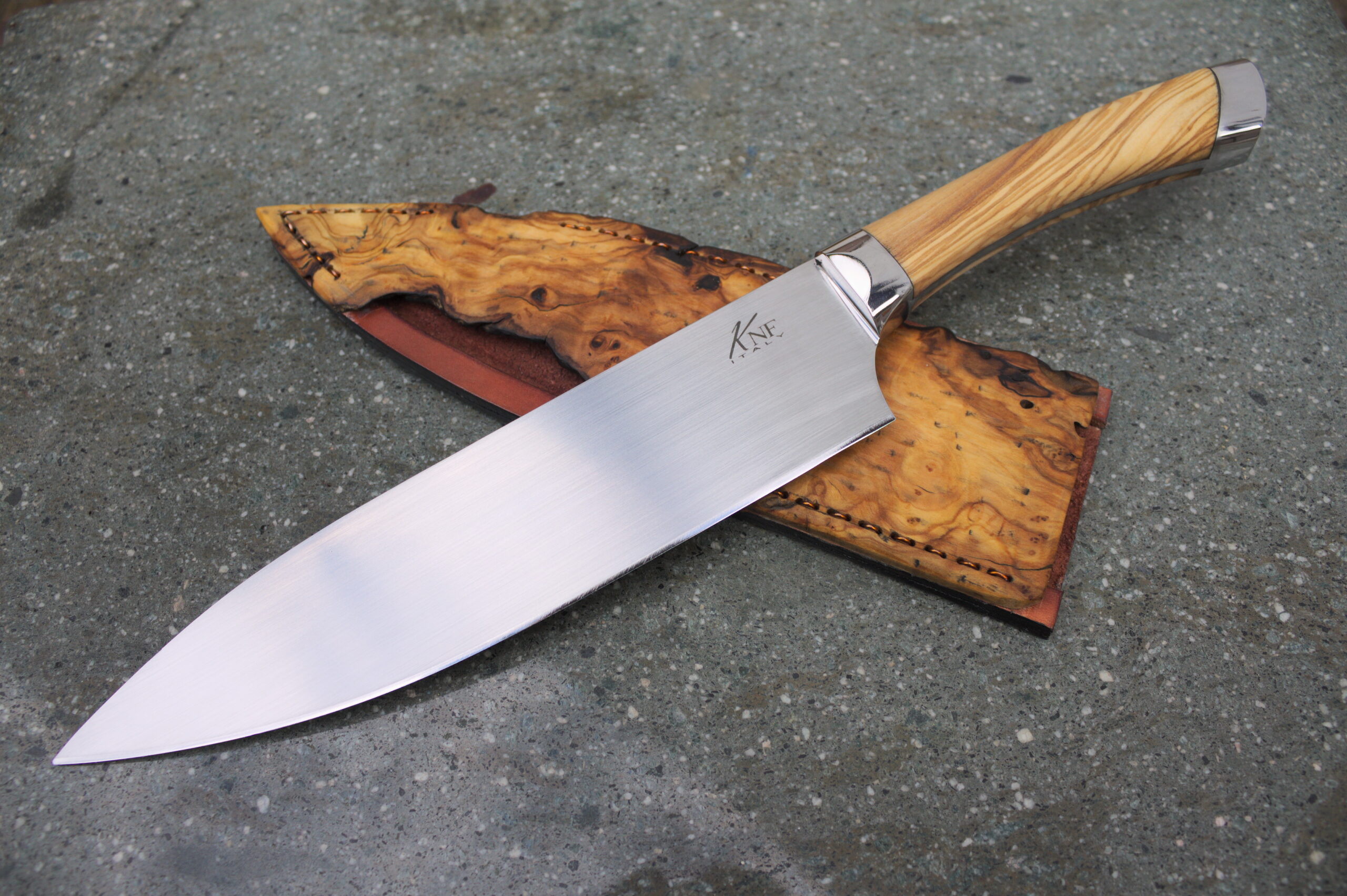
A chef’s knife that came out of the box slicing tomato skin without pressure will stop doing that in about four months. Most people blame the steel, or the price, or the fact that they bought it at a supermarket. In a large majority of kitchens the actual cause is a plastic basket in the bottom of the dishwasher.
Knives loaded loose in the cutlery basket spend an hour and a half knocking against forks, spoons and the basket itself while very hot water throws them around. Every one of those contacts is a microscopic dent in an edge that is only a few thousandths of an inch wide at the tip. Nothing about it looks dramatic, which is exactly why it goes unnoticed.
What follows is the short version of knife care for people who are never going to own a set of water stones: what to buy, what to skip, where to put the knife when it is clean, and the two minutes a week that keep it working.
- The one habit to stop: knives in the dishwasher, in any orientation
- Weekly: ten seconds on a honing rod, both sides
- Every two to four months: actual sharpening
- Cheapest real solution: a pull-through carbide and ceramic sharpener
- Best storage: magnetic strip or an in-drawer tray, not a crowded drawer
- Board: end-grain wood or plastic, never glass or stone
What the dishwasher actually does to an edge
Three things happen at once in there, and they compound. The first is mechanical: the wash arm moves loose items constantly, and a blade that touches a stainless fork at speed loses a fraction of its apex. Do that across a hundred cycles and the edge is a row of microscopic chips.
The second is chemical. Dishwasher detergent is far more alkaline than hand soap and contains mild abrasives, and it is designed to strip baked-on food rather than to be gentle with a polished bevel. On knives with any carbon content it also encourages spotting and pitting, which starts at the thinnest part of the blade because that is where there is least metal to lose.
The third is heat. The dry cycle runs hot enough to dry out and eventually shrink a wooden handle, which is how the gap opens up between the scales and the tang. Once water gets into that gap it stays there, and that is a hygiene problem as much as a cosmetic one.
A knife that has been through the dishwasher a few times is not ruined. One that goes through weekly for a year is a different object than the one that was bought, and no amount of sharpening brings back a handle.
Sharp, dull, and what is actually happening at the edge
An edge is two planes meeting at a line, and that line is where all the work happens. On a factory kitchen knife it is somewhere around fifteen to twenty degrees per side, and it is thin enough that it can be bent out of alignment without any metal being removed at all.
That distinction is the one that matters. A knife that has rolled over to one side feels dull and is not: the metal is all still there, just leaning. A knife that has genuinely lost material at the apex is dull in the real sense and needs an abrasive to fix it.
Which is why the two tools people confuse do completely different jobs. A honing rod pushes a rolled edge back into line and removes essentially nothing. A sharpener grinds new metal away to form a new apex. Honing weekly delays sharpening; it never replaces it.
The test is a sheet of ordinary printer paper held in one hand. A sharp knife enters at the top corner and slides down through it in a clean line. A dull one catches, tears, or needs sawing. It takes three seconds and it is more reliable than looking at the blade.
The pull-through sharpener, assessed honestly
Purists dislike them and the objection is legitimate: a pull-through sets the angle for you, it removes more metal than a stone does for the same result, and the coarse carbide side scratches a visibly rough edge. Used every week on a good knife, it will shorten its life measurably.
Used correctly, though, it solves the actual problem, which is that most kitchen knives are not sharpened at all. Six pulls through the coarse slot and six through the fine ceramic slot, straight and with light pressure, gets a supermarket chef’s knife back to cutting tomato skin in under a minute.
Two rules make it far less destructive. Skip the coarse carbide slot entirely unless the knife will not cut paper at all, since the ceramic side alone maintains an edge that is merely tired. And pull the whole length of the blade through in one motion, heel to tip, rather than working the middle repeatedly, which is how knives end up with a curved belly and a flat spot.
The other honest note: they are made for symmetrical Western knives. A single-bevel Japanese knife pulled through one of these has its geometry destroyed in one pass and cannot be repaired at home. It is one of the few cheap gadgets that earns its drawer space, provided it is matched to the knife.
What a stone gives you, and what it costs
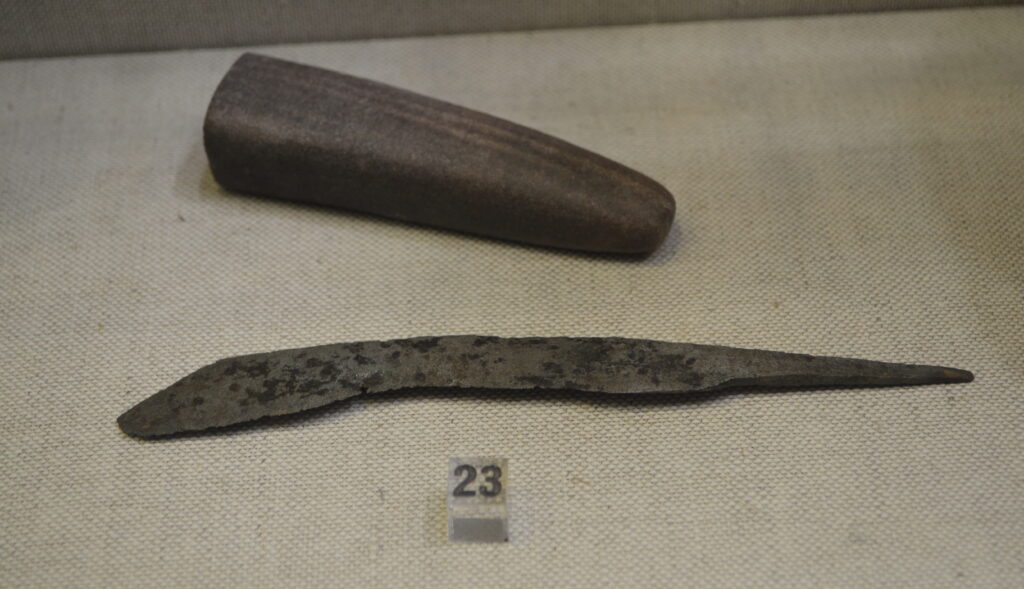
A sharpening stone produces a better edge than any gadget, keeps the knife’s original geometry, and removes only as much metal as you choose to remove. A combination stone at around 1000 grit on one side and 3000 on the other handles everything in a home kitchen and costs less than a mid-range knife.
The cost is not money, it is attention. Soaking, setting a consistent angle by feel, raising a burr along the full length, flipping, and finishing takes fifteen to twenty minutes per knife the first several times. The angle is the hard part, and a wobbling hand produces a convex edge that cuts worse than what you started with.
The realistic assessment is this: if you have tried a stone twice and it is still in a cupboard, you are not going to use it, and a knife maintained badly with a pull-through outperforms a knife maintained perfectly in theory. Buy the tool you will actually pick up.
| Method | Time per knife | Skill needed | Metal removed | Realistic frequency |
|---|---|---|---|---|
| Honing rod | 15 seconds | Low | Almost none | Weekly |
| Pull-through, ceramic slot | 1 minute | None | Moderate | Every 2 months |
| Pull-through, carbide slot | 1 minute | None | A lot | Rescue only |
| Whetstone, 1000 and 3000 | 15 to 20 minutes | High at first | Controlled | Twice a year |
| Professional service | Drop off and collect | None | Controlled | Once a year |
Sending knives out once a year is an underrated option, especially for anyone with one good knife rather than a set. Hardware stores, butchers and farmers markets in most towns have someone who does it, and the cost per knife is usually a few dollars.
How to take care of kitchen knives, in five habits
Everything worth knowing about how to take care of kitchen knives fits into five things that take almost no time. None of them requires a new purchase except possibly the third.
- Wash by hand, immediately after use, with warm water and dish soap on a sponge. Ten seconds, and it never goes into a sink full of water where it cannot be seen.
- Dry it completely with a towel before it goes away. Air drying leaves water sitting in the gap where the blade meets the handle.
- Hone weekly, five light passes per side on a rod at roughly a twenty degree angle. Weight of the blade only, no pressure.
- Store it where nothing metal can touch the edge. That is the entire criterion.
- Cut on wood or plastic, and never on glass, ceramic, stone or a metal tray.
The first habit is the one that carries the most weight, and it is also the one that solves the safety problem. A knife submerged in a sink of soapy water is invisible, and reaching into that sink is how most kitchen knife injuries at home actually happen.
Storage that stops the chipping
A drawer full of loose knives is the dishwasher problem in slow motion. Every time the drawer opens, the blades slide into each other and into whatever else is in there, and the edges take the impact.
A magnetic strip on the wall is the best of the options and the cheapest. It holds the blade flat with nothing touching the edge, it keeps knives visible so the right one gets used, and it dries them by leaving air on both sides. Place the spine against the magnet first and roll the blade on, rather than slapping the edge into it.
An in-drawer knife tray is the answer for a household with small children or a kitchen with no free wall. Each blade sits in its own channel and nothing shifts when the drawer moves. Individual edge guards, the plastic sleeves that slide over a blade, are the low-cost version and work well as long as the knife is dry when it goes in.
The traditional block is fine and has one flaw worth knowing: the slots trap crumbs and moisture, and a wet knife pushed into a slot has nowhere to dry. Store the block away from the sink, insert knives spine-down where the design allows, and turn it upside down over the bin every couple of months.
The board decides how long an edge lasts
Glass and stone boards destroy an edge faster than anything else in a kitchen. The material is harder than the steel, so every stroke that reaches the surface blunts the apex instantly. Decorative marble slabs belong under cheese, not under a knife.
End-grain wood is the gentlest surface because the blade parts the fibers rather than scraping across them, and the fibers close again afterward. Edge-grain wood is close behind and cheaper. Both need oiling with food-grade mineral oil every month or so, and neither should ever be left sitting in water or run through a dishwasher.
Plastic boards are the practical choice for raw meat, poultry and fish, because they can be washed hot and replaced when the knife scores have gone deep. A board with deep grooves holds bacteria in places a sponge does not reach, and once the surface is heavily scarred it is a five dollar item to replace rather than a repair job.
Keep at least two boards and use one exclusively for raw protein. Cross-contamination is the most common way a home kitchen makes someone ill, and a single board that goes from raw chicken to salad greens with only a rinse in between is the textbook version of it. Wash the board and the knife with hot soapy water after raw meat, every time, before either touches anything that will be eaten uncooked. It is a small discipline that sits alongside the rest of the basic techniques worth getting right.
Washing and drying, thirty seconds total
Hot water, dish soap, a sponge, wiping from the spine toward the edge rather than along it. Never scrub across the edge with a scouring pad, and never use steel wool on a blade.
Acidic foods deserve a note. Tomato, lemon, onion and anything vinegared left on a blade for an hour will mark it, and on high-carbon steel it will etch a permanent gray patch within minutes. Rinse and dry after cutting those, even if you are coming back to the same knife in ten minutes.
Drying is not optional and takes five seconds. Water left in the join between the handle scales and the tang is what lifts a wooden handle over a few years, and rust that starts there is invisible until the handle is loose.
Steel, hardness, and how often it needs attention
| Blade type | Holds an edge | Rusts | Sharpening interval |
|---|---|---|---|
| Soft stainless, supermarket knife | Poorly | Rarely | Every 4 to 6 weeks |
| Mid-range German stainless | Well | Rarely | Every 2 to 4 months |
| Japanese stainless, harder steel | Very well | Rarely | Twice a year |
| High-carbon steel | Very well | Readily | Twice a year, dry it always |
| Serrated bread knife | Extremely well | Rarely | Years, then replace |
Harder steel holds an edge longer and chips more easily, which is the trade in one sentence. A hard Japanese blade that meets a frozen edge of butter or a chicken bone can lose a visible piece, while a softer German knife rolls instead and comes back with a rod.
Serrated knives are the exception to everything above. The points do the cutting and they stay sharp for years because they rarely touch the board, and no home method sharpens the scallops properly. Use one for bread and tomatoes, then buy a new one when it stops working.
Three knives, and the rest is optional
A chef’s knife of eight inches, a paring knife, and a serrated bread knife handle nearly everything a home kitchen does. Maintaining three knives properly is achievable; maintaining a fifteen-slot block is a chore nobody sustains, which is why the blocks in most kitchens contain twelve dull knives and one that gets used.
The money question comes up constantly and the answer is unromantic. A mid-priced stamped knife that is honed weekly and sharpened every two months outperforms an expensive forged knife that lives in a drawer. Sharpening habits beat purchase price by a wide margin, which is the same logic that applies to most of the tools that genuinely earn counter space.
A dull knife is also the more dangerous one. It needs force to get through an onion skin, force makes it slide, and a blade that slips under pressure travels toward whatever is holding the food. Every kitchen injury statistic points the same direction on this, and it is the practical argument for the ten seconds on a rod.
Frequently Asked Questions
My knives already went through the dishwasher for years. Are they finished?
Almost certainly not. Sharpening restores the edge, and a scratched or spotted blade is cosmetic. The only unfixable damage is a handle that has cracked or come loose from the tang, and that one is worth replacing the knife over.
Does a honing rod need to be steel?
No. Steel rods realign an edge and remove nothing, which is the classic version. Ceramic rods do the same job and remove a very small amount of metal, so they revive a slightly dull knife better. Diamond rods actually sharpen and should be used sparingly.
How do I know when honing is no longer enough?
When the paper test fails right after honing. A rod straightens what is bent; if the edge is still tearing paper after ten passes, the metal at the apex is gone and an abrasive is the only thing that will bring it back.
Are electric sharpeners worth it?
The good ones work well and the cheap ones grind aggressively at a fixed angle and eat a blade. If you own several knives and will not use a stone, a quality electric model is defensible. For one or two knives, a manual pull-through and an annual professional sharpening costs far less.
Can I put the knife in the dishwasher if the maker says it is safe?
The label usually means the steel will not corrode, not that the edge will survive. The rattling and the detergent are the same regardless of what the box says. Handwashing takes ten seconds and there is no version of this where the machine is better for the blade.
What about ceramic knives?
They hold an edge for a very long time and they are brittle, so they chip on bone, frozen food and hard squash, and a chipped ceramic blade cannot be repaired at home. Treat them as slicers for soft produce and keep a steel knife for everything else.
Take the knife you use most out of the drawer tonight and run it down a sheet of paper. Whatever it does in that half second tells you which of the two tools in this article you actually need to buy.