
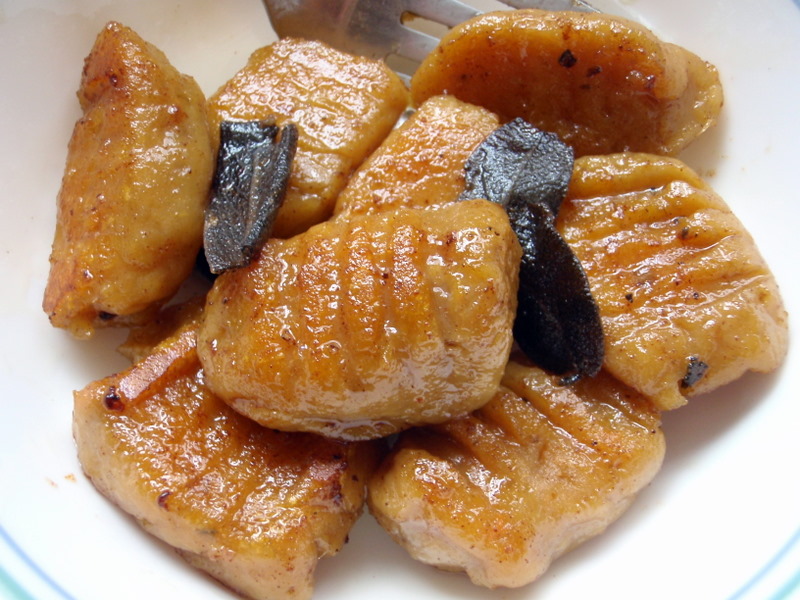
A vacuum pack of gnocchi costs about two dollars and sits on the dry goods shelf next to the pasta for the better part of a year. The back of the pack says to boil it for two minutes, until the pieces float. That instruction is the reason most people think gnocchi is soft, heavy and a little sad.
Tipped straight into a hot pan with a film of oil instead, the same dumplings come out with a thin crackling shell and a chewy middle that still tastes of potato. Twelve minutes from opening the pack to sitting down, no pot of water to bring up to temperature, and the sauce gets built in the same pan while the gnocchi waits on a plate.
Two things decide whether this works. Which of the three kinds of gnocchi in the store you bought, and whether you crowded the pan. Everything else is forgiving.
- Total time: 12 minutes for two people, 16 for four
- Gnocchi: one shelf-stable vacuum pack, roughly 17 ounces
- Pan: 12 inch skillet, nonstick or well-seasoned cast iron
- Fat: 2 tablespoons oil, or 1 oil and 1 butter
- Heat: medium-high, and the first side is left alone for four minutes
- The one mistake: two packs in one pan
The three packs on the shelf, and only one of them does this
Gnocchi shows up in stores in three different states, and they behave nothing alike in a dry pan. The shelf-stable vacuum pack is the one this method was built around. It has been cooked and then dried down, so it arrives firm, faintly rubbery, and low enough in surface moisture to start browning almost immediately.
Refrigerated fresh gnocchi from the chilled case is softer and wetter. It works, but it wants an extra minute of patience and a slightly hotter pan, and the pieces are more likely to slump than to hold an edge. Frozen gnocchi goes in still frozen, never thawed, and sheds water for the first two minutes, so browning starts late and the pan needs to be genuinely hot before anything goes in.
Gnocchi in all three forms is mostly cooked potato bound with a little flour and sometimes egg, which is why the interior turns creamy rather than springy. The dried version has the least water and the most flour, and that combination is what gives you a shell.
Two things to check before the pack goes in the cart. A shelf-stable pack should sit tight and flat against the dumplings, and one that has swollen or is weeping liquid goes back on the shelf. Refrigerated gnocchi has a printed date and belongs in the cold part of the cart on the way home.
Boiling first is what kills the crust
Water does something specific and unhelpful to the outside of a dumpling. It swells the starch granules on the surface into a soft gel, and that gel holds onto water tenaciously. A boiled piece dropped into oil has to give up that surface water before its temperature can climb past the boiling point, and only above that point does browning begin.
By the time the shell finally dries out and colors, the inside has been hot for four or five extra minutes and has gone from creamy to pasty. That is the trade nobody explains: you can boil and then fry, but you pay for the crust with the texture underneath.
Straight from the pack, the surface is already dry. Contact with hot oil pushes it past the browning threshold inside the first minute, so the Maillard reaction and the crust it produces happen while the center is still coming up to temperature. Both finish at roughly the same moment.
The oil is doing double duty. It fills the gaps between the flat bottom of the pan and the round-ish bottom of each dumpling, so heat transfers evenly instead of only at three contact points. Skip the fat and you get scorched dots on an otherwise pale surface.
Crispy skillet gnocchi in twelve minutes, start to finish
- Set a 12 inch skillet over medium-high heat and give it two full minutes empty. A pan that is merely warm will stick.
- Add 2 tablespoons of a neutral oil and tilt it around. It should shimmer and move like water within about fifteen seconds.
- Open the pack and tip the gnocchi straight in. Do not rinse it, do not separate the pieces first, and do not add salt yet.
- Shake the pan once to settle everything into a single layer, then leave it alone for four minutes. No stirring, no checking.
- Turn the pieces with a thin spatula. Roughly half will have a mahogany patch on the down side. Spread them back out.
- Give it another three to four minutes, turning once more halfway. Total pan time runs eight to ten minutes depending on your burner.
- Season with salt now, off the heat, and move the gnocchi to a plate. Leaving it in the pan while you build a sauce softens the crust.
- Build one of the three sauces below in the same unwashed pan, then return the gnocchi and toss for fifteen seconds, no longer.
The order in step seven is the part people skip. Gnocchi sitting in a warm pan continues to steam itself, and a shell that took eight minutes to build gives up in ninety seconds.
Pan, fat, and the eight minutes of not touching it
Nonstick is the easy answer and browns slightly less aggressively than bare metal. Well-seasoned cast iron gives the deepest color and holds its temperature when a cold pack goes in, which matters more than anything else on a weak burner. Bare stainless works but demands more oil and more nerve, because the pieces weld themselves down for the first ninety seconds and then release on their own.
Two tablespoons of oil for a full pack is the floor. Olive oil is fine here despite the usual warnings, since the pan never gets past medium-high, but a neutral oil browns more evenly. A tablespoon of butter added in the last two minutes is the best of both, and it goes in late because butter left in a hot pan for eight minutes is finished before the gnocchi is.
The four minutes of not touching anything is the whole discipline. Every turn resets the contact surface and drops the pan temperature, and gnocchi that gets stirred every thirty seconds ends up uniformly beige and soft. The pieces will release themselves when the crust forms. If a piece resists the spatula, it is not ready.
One layer, and what happens when you push past it
A single pack in a 12 inch pan sits in one loose layer with a little room. Two packs sit in a pile, and a pile traps the water coming out of the bottom layer. The result is a pan of dumplings poaching in their own steam, and extra time does not fix it, because the temperature at the top of the pile never gets above boiling.
| Pan | Comfortable amount | What happens if you double it |
|---|---|---|
| 10 inch skillet | Half a pack, serves one | Steams from minute two, no crust anywhere |
| 12 inch skillet | One full pack, serves two | Spotty color, soft middles, adds five minutes |
| 14 inch or a wide braiser | One and a half packs, serves three | Edges brown, center of the pan stays pale |
| Half sheet pan at 425 | Two packs, serves four | Works, but takes 22 minutes and needs a flip |
For four people the honest options are two rounds in the same pan, holding the first batch on a plate, or the oven route in the last row. Two rounds is faster than it sounds because the pan is already hot for the second one, which then takes about six minutes instead of nine.
Sauce one: butter and sage, foamed in the same pan
Off the heat, drop 3 tablespoons of butter and about ten sage leaves into the pan the gnocchi just left. The residual heat foams the butter and crisps the sage in under a minute, and the leaves go from limp to shatteringly brittle right as the foam subsides.
A squeeze of lemon and a grind of black pepper go in at the end, then the gnocchi, then a handful of grated hard cheese off the heat. The sauce is four ingredients and takes ninety seconds, which is why it is the default here.
Sauce two: burst cherry tomatoes and torn basil
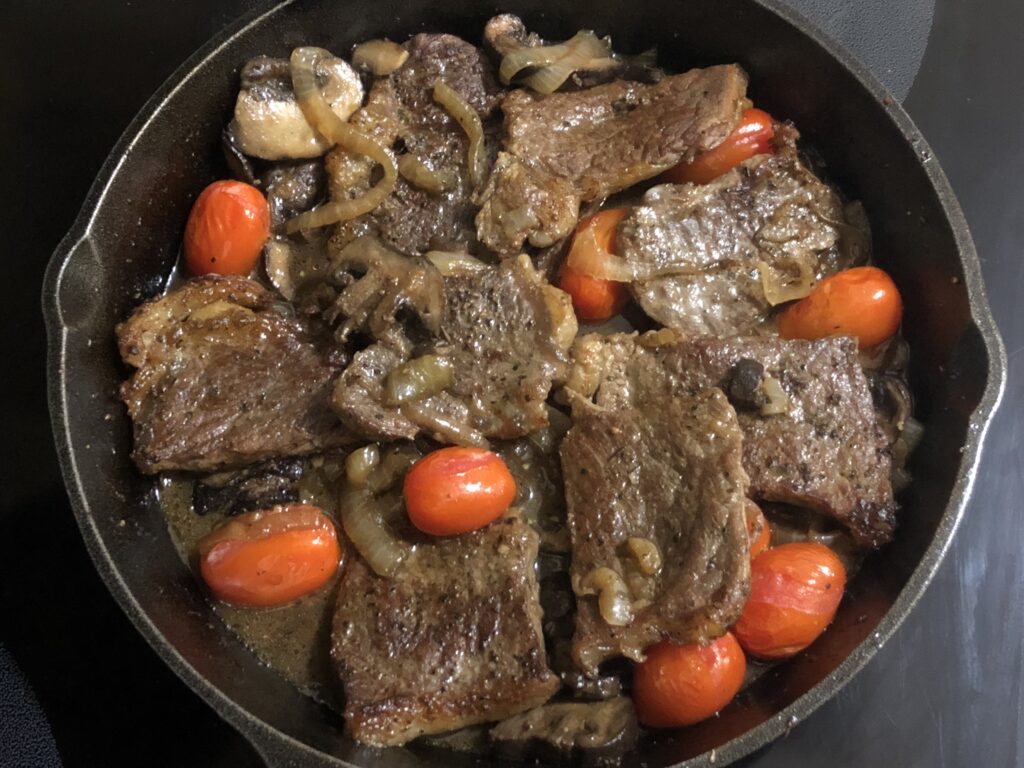
A pint of cherry tomatoes and two sliced garlic cloves go into the hot pan with a tablespoon of oil. Leave them for three minutes without stirring and the skins blister and split on their own, which is the point; a stirred tomato releases its water slowly and you end up simmering rather than blistering.
Press about a third of them with the back of a spoon once they have softened, add a pinch of chili flakes and a splash of water to loosen what is stuck to the pan, and let it bubble for one more minute. Torn basil and the gnocchi go in off the heat.
This is the version that scales best to feed a table, and the only one of the three that improves with an anchovy melted into the oil at the garlic stage.
Sauce three: lemon cream with spinach
Half a cup of heavy cream, the zest of one lemon and a large handful of spinach go into the pan over low heat. The spinach collapses in about ninety seconds and the cream thickens just enough to coat, which is all it needs to do since the gnocchi is already crisp and does not want to be swamped.
Lemon juice goes in at the very end and off the heat. Acid added to cream that is still bubbling can curdle it, and a sauce that has split looks grainy and will not come back together.
The trade-off is timing. This is the sauce that softens the crust fastest, so it should be plated and eaten immediately rather than held. If dinner is going to sit for ten minutes, make the tomato one.
Three sauces, measured against each other
| Sauce | Extra minutes | What it needs from the pantry | How long the crust survives |
|---|---|---|---|
| Butter and sage | 2 | Butter, sage, lemon, hard cheese | About 6 minutes |
| Burst cherry tomatoes | 5 | Cherry tomatoes, garlic, basil, chili | About 4 minutes |
| Lemon cream and spinach | 4 | Cream, lemon, spinach | About 2 minutes |
| Nothing at all | 0 | Salt, pepper, a lemon wedge | As long as it takes to eat |
The last row is not a joke. Salted and eaten from the pan with a lemon wedge, this lands closer to a bowl of hot snacks than to dinner, and it happens here more often than any of the three sauces. The rest is ordinary pan sauce work.
Refrigerated, frozen, gluten-free: what changes
Refrigerated gnocchi needs the pan a notch hotter and about a minute longer on the first side, and it benefits from being patted with a paper towel before it goes in. It also sticks more, so this is the one case where nonstick genuinely outperforms cast iron.
Frozen gnocchi goes in frozen. Thawing it produces a wet, sagging lump that will not brown at all. Expect the first two minutes to look like a failure while the ice sublimates off, then normal behavior once the pan dries out. Add three minutes to the total.
Gluten-free gnocchi, usually built on rice flour or a starch blend, browns fast and burns faster. Drop the heat to medium and check at three minutes rather than four. Cauliflower gnocchi holds far more water, wants a covered pan for the first five minutes, and never crisps the way the potato version does.
Homemade gnocchi is the one exception to the whole premise. Fresh dough that has never been cooked has to go through water first, because the interior needs a wet heat to set. It is a genuinely different project, and anyone going down that road will find the technique sits alongside traditional fresh pasta work rather than alongside this.
When it goes wrong, the step that caused it
- Everything is pale and soft. The pan was crowded, or it was not hot enough before the gnocchi went in. Those are the only two causes.
- The pieces welded to the pan and tore. Turned too early. A crust that has formed releases itself; one that has not will not let go.
- Crisp outside, chalky inside. The heat was too high and the outside finished before the middle. Drop to medium and add two minutes.
- Dark and bitter in patches. Not enough oil, so the pieces made point contact with bare metal instead of sitting in a film of fat.
- It was crisp in the pan and soft on the plate. The gnocchi sat in the pan while the sauce was built. Move it out first, every time.
Leftovers are a different animal. Cooked gnocchi should go into a shallow container and into the refrigerator within two hours of coming off the heat, or within one hour if the kitchen is hot, and it is good for three days. Reheat it in a dry pan over medium heat rather than a microwave, which drives moisture back into the shell and undoes the entire point. The cream sauce version does not survive the fridge well and is worth finishing the night it is made. Anything that has sat out overnight goes in the bin regardless of how it looks, and that applies to the one-pan version of any dinner, including the one-pan family dinners that follow the same holding rules.
Frequently Asked Questions
Does the gnocchi need to be defrosted or rinsed first?
Neither. Rinsing adds the surface water this method exists to avoid, and thawing frozen gnocchi produces a soft mass that slumps in the pan. Straight from the pack or straight from the freezer, into hot oil.
Can I do this on a sheet pan instead?
Yes, at 425 degrees, tossed with oil, in a single layer, for about 22 minutes with one flip at the halfway point. The crust is thinner and more even, the interior is drier, and it handles four servings at once. It is a good trade when you are cooking for a table.
Why did mine taste raw in the middle?
Shelf-stable gnocchi is already cooked, so what you are tasting is starch that never got hot enough to soften rather than anything undercooked in the safety sense. Lower the heat and give it two more minutes; a piece cut open should be uniformly soft, not chalky at the core.
How much does a plate of this cost?
Roughly a dollar a serving for the gnocchi itself, and the sage butter version adds maybe forty cents. The tomato sauce is the most expensive of the three out of season and the cheapest in August. It is one of the few dinners where the pantry version and the fancy version are within a dollar of each other.
Can I add protein and keep it to one pan?
Brown sliced sausage or chunks of pancetta first, move the meat to a plate, then cook the gnocchi in the rendered fat and return everything at the end. Skip the extra oil if the pan looks well coated. Chicken does not work as well because the timing does not line up.
Buy one pack and cook it plain, with salt and lemon and nothing else, before bothering with a sauce. The browning is the skill, and it takes one attempt to learn what the pan looks like at minute four.