
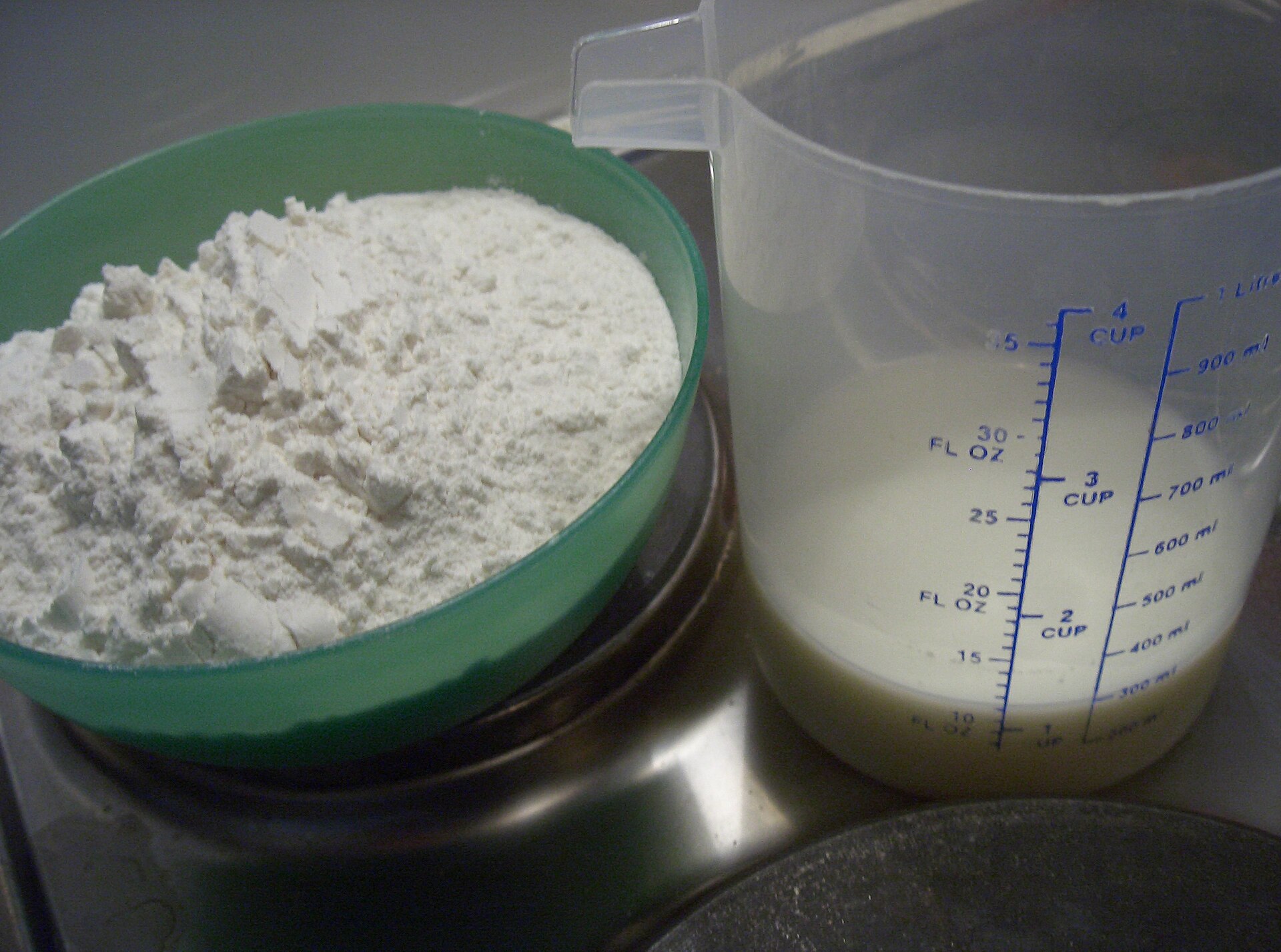
One bag of all-purpose flour, one dry measuring cup, six people, and the same instruction: give me one cup of flour. Nobody was told how. Each cup went straight onto a scale and the number was written down before the next person came in.
The lightest was 118 grams. The heaviest was 152. That is a difference of 34 grams, or close to a third of a cup of flour, between two people who both believed they had done exactly what was asked.
Nothing about this is a criticism of the six. It is a criticism of the instruction, because a cup is a measure of volume and flour is a powder that can hold half again as much of itself in the same space depending on how it got there.
- The spread: 118 to 152 grams for one cup of all-purpose flour
- The standard: 120 to 125 grams per cup, which most recipes assume
- The heavy method: dipping the cup into the bag, every time
- The fix without a scale: fluff, spoon, level
- What it changes: spread in cookies, crumb in cake, hydration in bread
- Do not taste the dough: raw flour is not a ready-to-eat food
The test, and how it was set up
Everything was held constant except the person. One five pound bag of a national brand of all-purpose flour, opened that morning, in a canister rather than the bag itself. One standard dry measuring cup, the metal kind. One kitchen scale zeroed before each measure. Room at normal indoor humidity.
Each person came into the kitchen alone, was asked for one cup of flour, and was not allowed to watch anyone else. Afterward each was asked to describe what they had done. That second part turned out to matter more than the numbers.
Nobody used a technique they had been taught. Every one of the six was doing something they had picked up by watching a parent or by working it out on their own, and no two descriptions matched.
Six cups, six weights
| What they did | Weight | Against the 120 gram standard |
|---|---|---|
| Spooned into the cup, leveled with a knife | 118 g | Slightly under |
| Spooned in, leveled with a finger | 124 g | On target |
| Poured from the canister, leveled | 127 g | Marginally over |
| Dipped the cup, leveled with a knife | 133 g | 11 percent over |
| Dipped and shook it flat | 141 g | 18 percent over |
| Dipped, tapped on the counter, topped up | 152 g | 27 percent over |
The pattern is clean and it is not about care. The person who produced 152 grams was the most conscientious of the six: they tapped the cup to settle the flour so it would be level and honest, then added a little more to fill the gap that tapping created. Doing it thoroughly is what produced the largest error.
The three lightest results all involved moving flour into the cup with something other than the cup. The three heaviest all involved pushing the cup into the flour, which compresses it against the bottom of the container.
What 30 grams does to a batch of cookies
A standard drop cookie recipe uses about two and a quarter cups of flour. At the light end of the test that is 265 grams. At the heavy end it is 342 grams, which is nearly 30 percent more flour in the same amount of butter, sugar and egg.
The visible result is spread. Flour absorbs the liquid in a dough and provides the structure that stops it flowing sideways in the oven, so a heavy measure produces a cookie that stays as a mound and bakes pale, dry and cakey. A light measure produces a cookie that spreads thin, browns fast and can pool into its neighbor.
People generally read this as an oven problem or a butter temperature problem. Both of those matter, and neither moves the result as far as 77 grams of flour does.
The same error in a cake
Cake is less forgiving than cookies because there is nowhere for the extra flour to go. The batter is a foam held up by a balance of flour, fat, sugar and eggs, and adding a quarter more flour thickens it enough to trap the bubbles instead of letting them expand evenly.
The tells are consistent: a domed and cracked top, a dense band near the bottom, a dry crumb, and a cake that is noticeably shorter than the one in the picture. A cake made with too little flour goes the other way and sinks in the middle as it cools, because the structure cannot hold the weight of its own moisture.
A cake is also where the error compounds. Most recipes call for two or three cups, so a person measuring heavy is 60 to 90 grams over before anything else has been weighed, and that is the difference between a tender crumb and something people describe as fine but a bit dry.
In bread, where it stops being a texture question
Bread is where the volume measure genuinely breaks down, because bread is described in ratios. Hydration, the weight of water against the weight of flour, is the number that decides whether a dough is slack and open or tight and dense.
A recipe calling for three cups of flour and a cup and a half of water is aiming at roughly 70 percent hydration if a cup weighs 120 grams. Measured at 152 grams a cup, the same recipe lands near 55 percent, which is not a slightly stiffer dough but a different formula producing a different bread.
This is why bread recipes written by people who bake seriously give weights first and cups as an afterthought or not at all. Once you are managing gluten development and fermentation time, an unknown 25 percent variable in the main ingredient makes the rest of the instructions meaningless. Anyone working through a first artisan loaf hits this in the first week.
How to measure flour correctly without a scale
Learning how to measure flour correctly by volume is three motions, and done consistently it lands within a few grams of the 120 gram standard every time.
- Fluff. Stir the flour in its bag or canister with a fork or a whisk for five seconds. Flour settles and compacts as it sits, and this undoes that.
- Spoon. Use a spoon to transfer flour into the measuring cup, letting it fall in loosely. Do not press it, do not tap the cup, do not shake it flat.
- Level. Sweep across the rim with the back of a knife or any straight edge, in one pass, letting the excess fall back into the container.
The whole thing takes about fifteen seconds per cup. The only part people get wrong after learning it is the tapping, which feels like tidiness and is actually compaction.
One more detail that matters: measure over the container, not over the mixing bowl. A spill from a leveling pass that lands in the bowl is flour you did not measure and cannot remove.
Why the dipping habit is so hard to break
Dipping is faster, it uses one hand, and it feels correct because the cup comes out full and level. There is nothing about the action that signals a problem, which is why it survives decades of baking without being questioned.
It also has a legitimate history. Plenty of older American recipes were written by people who dipped, so they were internally consistent with a heavier cup, somewhere around 140 grams. A recipe from a mid-century community cookbook made with a carefully spooned cup can come out wetter than intended for exactly that reason.
The practical takeaway is that consistency inside a single recipe matters more than matching a standard. If a recipe has always worked for you when dipped, keep dipping it. The problem arrives when a recipe written by someone who spoons is made by someone who dips, which is most of the time on the internet.
Not every flour weighs the same per cup
| Ingredient | Grams per cup, spooned | Notes |
|---|---|---|
| All-purpose flour | 120 to 125 | The reference in most recipes |
| Bread flour | about 127 | Slightly denser and thirstier |
| Cake flour | about 115 | Finer, lighter, clumps more |
| Whole wheat flour | about 120 | Absorbs more water regardless of weight |
| Cocoa powder | about 85 | The biggest surprise on this list |
| Powdered sugar | about 120 | Always sift, it compacts hard |
Cocoa is the one worth memorizing. At 85 grams a cup it is far lighter than flour, and anyone who dips a cup into a tub of cocoa and packs it can end up with 40 percent more than the recipe wanted, which is enough to make a cake dry and bitter in one step.
Gluten-free blends vary more than anything else on the list, since each brand uses a different mix of rice flour, starch and gums with different densities. For those, the manufacturer’s stated weight per cup is the only reliable number.
Sifted before or sifted after, which are different amounts
Two phrasings look identical and are not. One cup sifted flour means sift first, then measure the sifted flour into the cup. One cup flour, sifted means measure first, then sift what you measured.
The gap is around 20 grams, because sifting aerates flour and a cup of it holds less once it has been through a sieve. In a delicate cake that difference is visible in the finished crumb.
The comma is doing all the work in that sentence, which is a good argument for weights on its own. A recipe in grams removes the ambiguity entirely, and sifting becomes what it should be, a step for removing lumps and combining dry ingredients rather than a measuring method.
What a scale costs and what it replaces
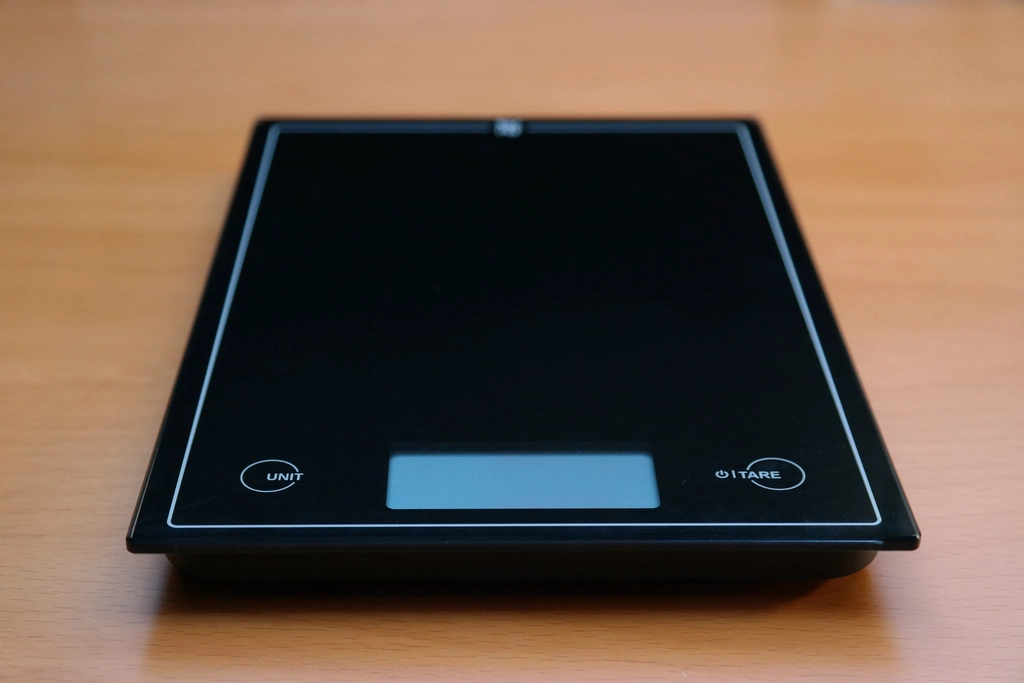
A digital kitchen scale that reads in grams costs about the same as a bag of good chocolate. It replaces the entire set of dry measuring cups for baking, and it removes the washing up that goes with them, since everything goes into one bowl with the tare button pressed between additions.
The features that matter are a gram increment, a tare button, and a capacity of at least five kilograms. A backlit display and a removable platform are conveniences. Anything that reads only in quarter ounces is not precise enough for the job.
The habit that makes it worth the counter space is putting the mixing bowl on the scale and building the recipe inside it. Flour, tare, sugar, tare, cocoa, tare. There is no cup to fill, level, empty and refill, and the whole dry side of a cake gets measured in about forty seconds. It is the single change that most improves consistency in home baking, more than any technique in the artisan repertoire.
Humidity, old flour, and the variables nobody controls
Flour is hygroscopic, meaning it takes up moisture from the air. A bag that has been open in a humid kitchen through August weighs more per cup and behaves as though it were slightly wet, which is why doughs run stickier in summer and stiffer in a dry winter kitchen.
This is a real effect and a small one next to the measuring error. It is worth adjusting for by feel rather than by arithmetic: hold back a couple of tablespoons of liquid in a bread dough on a humid day and add it if the dough looks tight.
Storage matters more for flavor than for weight. Whole grain flours contain the germ and its oils, so they go rancid within a few months at room temperature and belong in the freezer. White flour keeps a year in a sealed container in a cool cupboard, and a sealed container is also the answer to pantry pests, which arrive in the bag more often than anyone likes to think about. This is the part of the pantry that rewards attention alongside any serious bread project.
Raw flour is not a safe snack
The instinct to taste the dough deserves a flat answer: do not. Flour is a raw agricultural product that has not been treated to kill pathogens, and it has been the source of multiple recalls linked to E. coli and salmonella. The eggs get the blame for raw dough and the flour is the more common culprit.
Baking solves it, because the temperature inside a cookie or a loaf goes well past what those organisms survive. What does not solve it is a quick taste from the bowl, a scraped beater, or a spoonful of batter handed to a child while the tray goes in the oven.
For deliberately edible dough there is a real method. Spread the flour on a sheet pan and heat it at 350 degrees until it reaches 165 degrees measured with an instant-read thermometer, usually about five to seven minutes, then cool it completely before using. Use pasteurized egg or no egg at all, and treat the result as a refrigerated food.
Wash hands, bowls and the counter after handling flour, particularly before touching anything that will be eaten raw. A dusting of flour across a work surface travels further than it looks like it does.
Frequently Asked Questions
If a recipe only gives cups, what weight should I assume?
Use 120 grams per cup of all-purpose flour and adjust from there. Most recipes written in the last twenty years by anyone who tests carefully are built on 120 to 125. If the result comes out dry, drop to 115 next time and note it on the page.
Does the shape of the measuring cup matter?
Only in that dry cups are designed to be leveled and liquid measuring jugs are not. Measuring flour in a glass jug with a spout means you cannot sweep the top flat, so you are estimating against a line, which adds error on top of the error already there.
Is 30 grams really enough to notice?
In one cookie, barely. Across a recipe using three cups, the accumulated difference is close to a full extra cup of flour, and that is the difference between a tender cake and a dry one. The error scales with the recipe, which is why bread suffers most.
Can I just add a splash more liquid to fix a heavy measure?
Sometimes, and it is guesswork. In a batter you can loosen it by feel with a tablespoon of milk at a time. In a dough where the ratio drives fermentation, adding water after the fact changes the timing as well as the texture, so it is better to start from the right weight.
What about measuring by weight when a recipe gives volume for everything?
Convert the flour and the sugar, which are the two that carry most of the error, and leave teaspoons of baking powder and salt as they are. Small volumes of dense powders are consistent enough that a scale adds nothing.
Run the same test at home with whoever else cooks in the house. Two cups, one scale, five minutes, and the number on the display settles an argument that no amount of explaining ever does.