
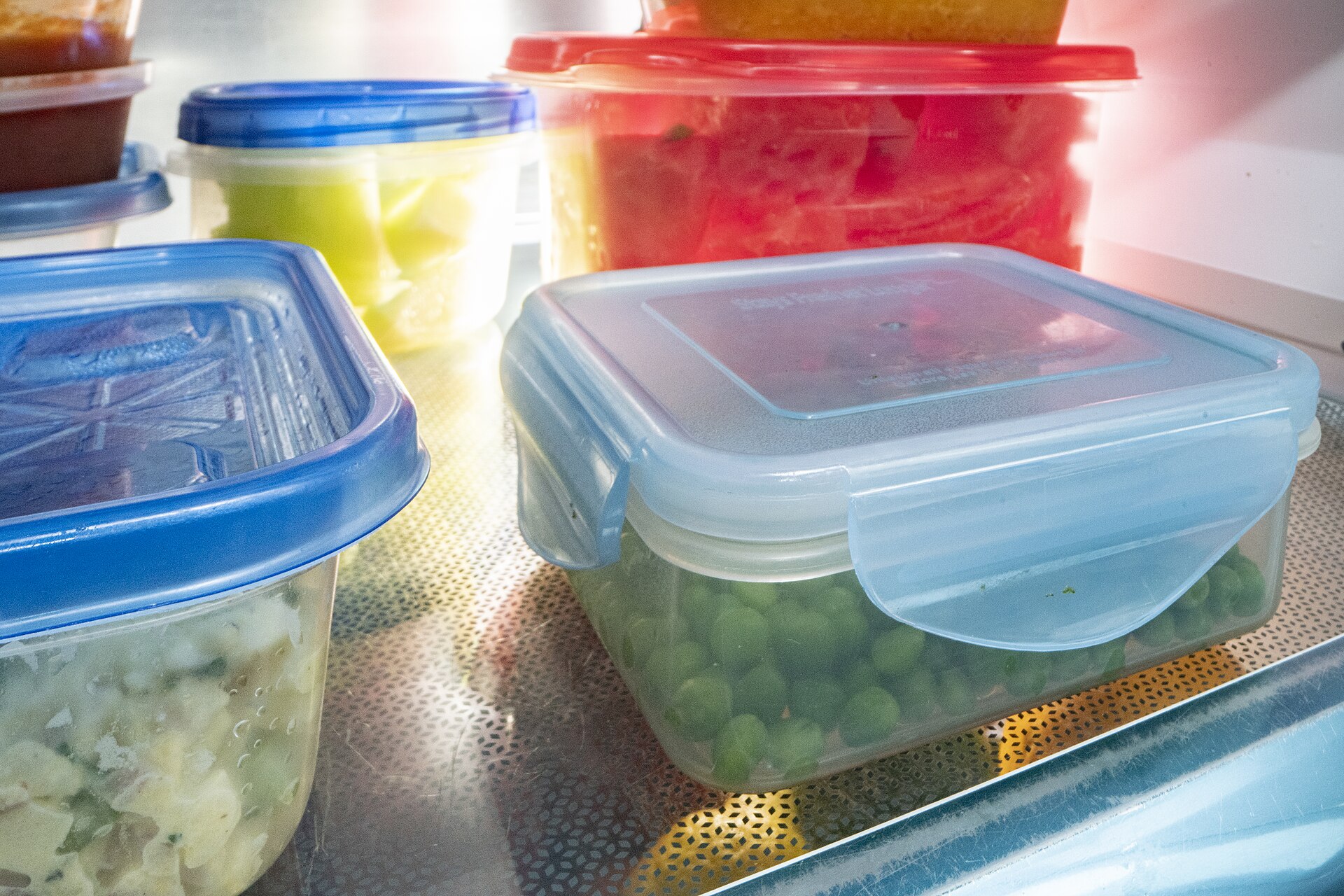
The container on the middle shelf is a soup from some point last week. It looks fine. It smells like soup. The question of whether to eat it gets settled by a quick sniff and a shrug, which is the method almost everyone uses and the one that works least well.
Most of what makes cooked food unsafe produces no smell, no discoloration, and no change in texture. The organisms that make food smell bad are usually spoilage organisms, which are unpleasant rather than dangerous. The ones that actually cause illness tend to leave the food looking and smelling completely normal.
So the useful test is not the nose. It is the date on the lid and the clock that started the moment the food came off the stove. What follows is the set of real windows, and the two habits that matter more than any of them.
- Most cooked leftovers: 3 to 4 days refrigerated at 40 degrees or below
- Out on the counter: 2 hours, or 1 hour above 90 degrees
- Reheating: steaming hot throughout, 165 degrees
- Cooling a big pot: shallow containers, lids off until the steam stops
- The freezer: stops the clock, does not reverse it
- The smell test: catches spoilage, misses the dangerous cases
What is actually happening inside the container?
Two separate processes, running at different speeds and producing different signals.
Spoilage is the work of organisms that break food down and make it unpleasant. They produce the sour smell, the slime, the off color, the fizz in a jar. They are mostly harmless in the sense that they will not make you ill, and they are useful precisely because they are so obvious.
The other process is the growth of organisms that cause illness, and it is silent. Food carrying enough of them to make somebody sick usually looks and smells exactly like food that does not. That is the whole reason time and temperature rules exist: they are a proxy for something you cannot perceive.
Refrigeration does not stop either process. It slows them down, and at 40 degrees it slows them enough that a few days is a reasonable margin. It is a brake rather than a switch.
So how long do leftovers last, in one table?
| Food | Refrigerated | Frozen, for quality |
|---|---|---|
| Cooked meat and poultry | 3 to 4 days | 2 to 6 months |
| Soups and stews | 3 to 4 days | 2 to 3 months |
| Cooked rice and pasta | 3 to 4 days | 1 to 2 months |
| Pizza | 3 to 4 days | 1 to 2 months |
| Cooked vegetables | 3 to 4 days | 2 to 3 months |
| Egg dishes and quiche | 3 to 4 days | 2 to 3 months |
| Gravy and pan sauces | 1 to 2 days | 2 to 3 months |
| Cut melon and cut fruit | 3 to 4 days | Texture suffers badly |
| Cooked fish | 3 days | 2 to 3 months |
| Deli meat, opened | 3 to 5 days | 1 to 2 months |
These windows follow the standard published guidance for home kitchens, which the United States government keeps in one place at FoodSafety.gov and which has not moved much in years. Three to four days covers the overwhelming majority of what a home kitchen produces, which is why it is the number worth memorizing. Gravy is the notable outlier at one to two days, because it is a warm, moist, protein-rich liquid, which is close to an ideal growth medium.
The frozen column is about quality rather than safety. Anything held continuously at zero degrees stays safe indefinitely; what degrades is texture and flavor, and those numbers are when it stops being worth eating rather than when it becomes a problem.
Why is cooked rice on a shorter clock than the chicken beside it?
Because of a specific organism. Uncooked rice commonly carries spores of a bacterium that survives boiling. Cooking kills the active cells and leaves the spores intact, and if the cooked rice then sits at room temperature, those spores germinate and the bacteria produce a toxin.
The toxin is the problem, because it is heat-stable. Reheating the rice kills the bacteria and does nothing to the toxin they already made, which is why reheated rice that sat out overnight is a known cause of illness in a way that reheated chicken that sat out is not quite the same.
The practical rule is simple: cooked rice goes into the refrigerator quickly, spread thin so it cools fast, rather than sitting in the pot on the stove until bedtime. Once it is cold it follows the same three to four day window as everything else. The same caution applies to cooked pasta and to cooked beans, though rice is where it comes up most.
This is also the reason a rice cooker left on warm all evening is fine and a rice cooker switched off at six and emptied at eleven is not. The organism behind it, Bacillus cereus, is only a problem in the temperature range between the two.
Does the smell-and-look test work?
It works in one direction and fails in the other, which makes it half a test.
If something smells sour, looks slimy, has visible mold, or fizzes when the lid comes off, that is reliable information and the answer is to throw it out. Spoilage organisms are honest.
If something smells and looks completely normal, that tells you almost nothing about whether it is safe, because the organisms that cause illness do not announce themselves. A container of chicken and rice that has been in the refrigerator for nine days can smell perfectly clean.
So the test that does work is the label. A piece of tape and a marker, with the date the food was cooked, converts an unanswerable question into a two-second one. Anyone who has run a proper meal prep system for a while ends up doing this, not out of caution but because it removes a small daily decision.
What is the two-hour rule, and when does it become one hour?
Cooked food should not sit between about 40 and 140 degrees for more than two hours in total. That is the range where bacteria multiply fastest, and two hours is the accumulated budget rather than a per-occasion allowance.
Above about 90 degrees ambient, the budget drops to one hour. That is a hot kitchen, a car, a picnic table in summer, or a covered dish sitting near a stove that has been running all evening.
The word accumulated is the part people miss. Food that sat out for ninety minutes at dinner, went into the refrigerator, and then sat out for another hour at lunch the next day has used more than its budget across the two occasions. Each trip out of the cold counts.
A buffet is the common failure case. A dish put on a table at six and cleared at nine has been out for three hours regardless of how good it looks, and the correct move is to refrigerate a portion at the start rather than to save what is left at the end.
How fast does a big pot need to cool?
Faster than it will on its own. A four-quart pot of hot stew left on a turned-off burner can hold its center above 100 degrees for several hours, which spends the entire time budget before the pot ever reaches the refrigerator.
The standard two-stage target is to get food from hot down to about 70 degrees within two hours, and from 70 down to 40 within another four. Both halves matter, and the first is the harder one.
| Method | Effort | Effect |
|---|---|---|
| Shallow containers, 2 inches deep | Two minutes | The single biggest improvement |
| Lid off until steam stops | None | Lets heat escape instead of condensing |
| Ice bath in the sink | Five minutes | Cuts cooling time roughly in half |
| Stirring while it cools | Occasional | Moves heat out of the center |
| Leaving the pot on the stove | None | The slowest possible option |
Putting a hot pot straight into a modern refrigerator is no longer the sin it was once treated as, since the appliance can handle it, but it does raise the temperature of everything on the shelf around it for a while. Shallow containers solve both problems at once.
Does reheating reset the clock?
No. This is the most common misunderstanding about leftovers and it is worth being blunt about.
Reheating kills active bacteria. It does not remove heat-stable toxins that were produced while the food was warm, and it does not undo the days already spent in the refrigerator. Food cooked on Sunday and reheated on Thursday is still four-day-old food on Thursday, and reheating it again on Saturday does not make it two days old.
The related habit worth changing is reheating a whole container repeatedly. Each cycle takes the entire batch through the warm range and back, and each cycle costs quality as well. Take out a portion, reheat that, and leave the rest cold.
What does reset the clock, more or less, is the freezer. Food frozen on day two comes out with roughly two days of its window used, and it is worth writing the original cooking date on the bag rather than the freezing date so that arithmetic still works months later.
What temperature does reheated food need to reach?
165 degrees throughout, measured with a thermometer in the thickest part or in the center of the container. Steaming hot is a reasonable proxy in the absence of a thermometer, and it means genuinely steaming rather than warm.
Microwaves are the usual weak point because they heat unevenly, leaving cold spots in the middle of dense food. Stir halfway through, cover the container so steam circulates, and let it stand for a minute or two afterward so the heat evens out. That standing time is part of the process rather than an afterthought.
Sauces and gravies should be brought to a full rolling boil rather than merely heated, which is one place where the older advice was right and the reason for it holds. Soups and stews reheat well on a stovetop; a dry roast reheats better covered in a low oven with a splash of liquid.
Which containers actually make a difference?
Shallow beats deep, every time, for both cooling and reheating. Two inches is the working depth.
Glass and hard plastic both work. Glass does not stain or hold odors and can go into an oven; plastic is lighter and does not break. Neither is meaningfully better at keeping food safe, so the choice is practical.
A real seal matters more than the material. A lid that clicks shut keeps odors from migrating and slows the drying that makes leftovers unappealing. Food left in the pot with foil over the top dries out, absorbs whatever else is in the refrigerator, and is the version most likely to be thrown away uneaten.
The container that matters most is the one with a date on it. Masking tape and a marker, the date written large enough to read from arm’s length, on the lid rather than the side. It is the cheapest thing in this article and it prevents most of the guessing.
What about cut fruit and opened jars?
Cut fruit is on the same two-hour counter clock as anything else and keeps three to four days refrigerated in a sealed container. Cut melon is the one to watch, since the rind can carry organisms that the knife transfers to the flesh, which is why washing the outside of a melon before cutting it is worth doing.
Opened jars vary widely and the label is the authority. As a general shape: mayonnaise two months, mustard a year, ketchup six months, jam six months to a year, and anything that says refrigerate after opening means it. Pesto and other fresh sauces are much shorter, usually a week.
Opened canned goods should not be stored in the can. Transfer to a container, since the metal affects flavor once the seal is broken. Most opened cans keep three to four days refrigerated, and tomatoes and other acidic contents are at the shorter end.
Can I freeze something on day three?
Yes, and it is the right move if you know you will not eat it. Freezing on day three preserves it as day-three food, which is fine as long as you eat it within a day of thawing rather than treating it as fresh.
Thaw in the refrigerator rather than on the counter, which keeps the outside of the food out of the warm range while the middle catches up. A large container takes a full day. Cold water thawing in a sealed bag with the water changed every half hour is the fast version and the food should be cooked immediately after.
Do not refreeze something that has fully thawed at room temperature. Food thawed in the refrigerator can be refrozen safely, with some loss of texture, which is a useful distinction when plans change. And label the bag with the original cooking date, not the freezing date, so that the remaining window is still visible in three months.
Which leftovers should just be thrown out?
Anything past four days, without further debate. Anything that was left out overnight, including the pot that was covered and looked fine in the morning. Anything with visible mold on a soft or moist food, since mold in those foods sends threads well beyond the visible spot.
Hard cheese and firm produce are the exception on mold, where cutting an inch around and below the spot is accepted practice. Soft cheese, bread, cooked dishes, jam, and yogurt with mold on them go in the bin whole.
Anything from a container that hisses, bulges, or sprays when opened, and any canned food from a swollen or leaking can, goes out without being tasted. Tasting is never a test. Any dish that is going to be served to a pregnant person, a young child, an older adult, or someone whose immune system is compromised should be held to a shorter window than the table above, since the consequences of getting it wrong are more serious for those groups. When there is genuine doubt, the cost of throwing out a portion is small measured against a day of illness, and it is the same arithmetic that makes planning what to do with leftovers ahead of time worth the effort.
Frequently Asked Questions
Is the four-day rule the same for everything?
Close to it, with two exceptions worth remembering. Gravy and pan sauces are one to two days, and cooked fish is closer to three. Everything else in an ordinary kitchen sits at three to four.
My refrigerator has no thermometer. Does the setting matter?
It does, and the dial is not a temperature. Put an inexpensive appliance thermometer on a middle shelf and adjust until it reads 40 degrees or below. A box running at 45 shortens every window in this article substantially.
Is it safe to eat leftover pizza left out overnight?
No. It has cheese and often meat on it, it has been in the warm range for eight hours or more, and it does not smell any different for it. This is the case where the two-hour rule most often gets ignored and it should not be.
Do restaurant leftovers get the same window?
Shorter, in practice, because the clock started when the dish was plated in the kitchen rather than when you got home. Count the time at the table and the drive, refrigerate promptly, and treat three days as the limit rather than four.
Can I put hot food straight into the refrigerator?
A modern refrigerator handles it, and it is better than leaving a pot on the stove. Divide it into shallow containers first so it cools quickly and does not warm everything around it, and leave the lids off until the steam stops.
What is the fastest way to know if something is still good?
Read the date you wrote on the lid. If there is no date, the honest answer is that you cannot know, and the safe assumption for an unlabeled container of unknown age is that it has been there longer than you think.
Buy a roll of masking tape and keep it in the drawer with the containers. Two seconds per lid removes almost every version of this question, and it is a better system than a good memory.