
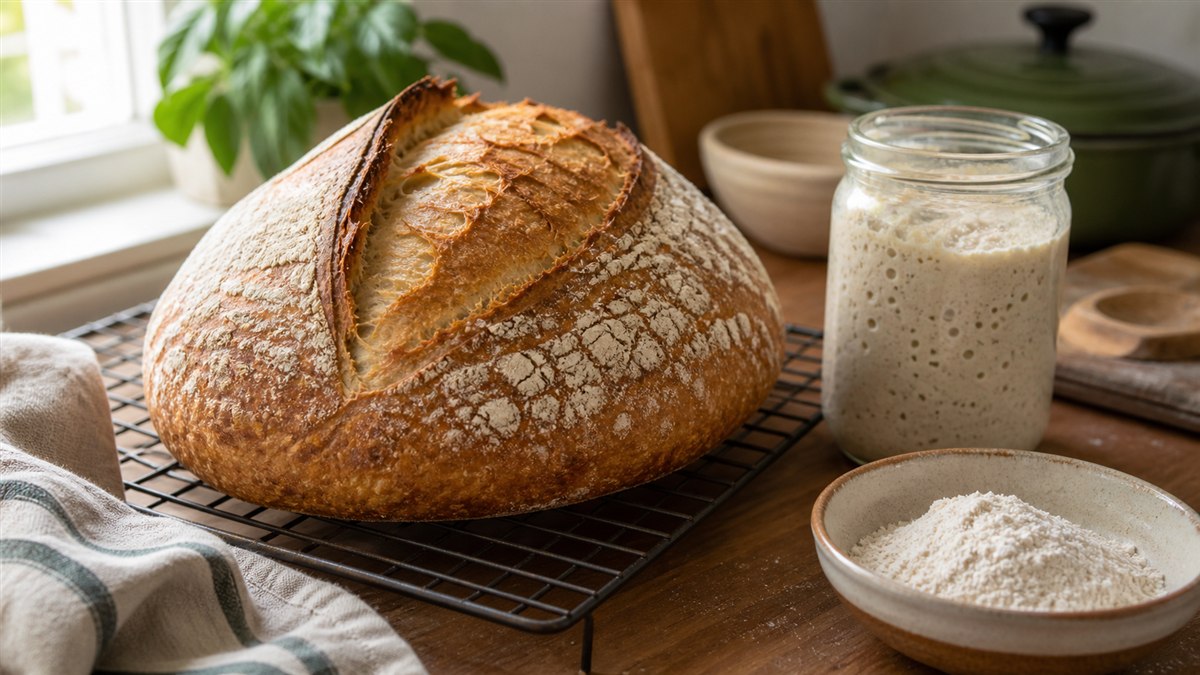
Sourdough becomes much easier when you stop treating the clock as the final authority. A starter is ready because it rises predictably. Bulk fermentation is complete because the dough has expanded and gained strength. A loaf is ready to slice because its interior has finished setting and cooling. Time and temperature help you plan, but the dough provides the decision.
This beginner guide explains those signals, offers a manageable starting formula, and shows how to diagnose common problems without inventing certainty from a single test.
By MunchieCooking Team · Last reviewed July 23, 2026
What sourdough starter actually needs
A starter is a maintained culture of wild yeast and lactic acid bacteria living in flour and water. Feeding provides fresh flour and dilutes accumulated acids. Temperature, flour choice, feeding ratio, and timing determine how quickly the culture rises and falls.
A new starter can appear extremely active in its first few days and then become quiet. That early burst does not necessarily mean it is ready to raise bread. According to King Arthur Baking’s starter guidance, establishing a new culture may take up to two weeks. Consistency matters more than one dramatic rise.
A simple feeding routine
For a small room-temperature starter, keep 25 grams of starter and feed it 25 grams of water plus 25 grams of flour. This is a 1:1:1 feeding by weight. Mix thoroughly, mark the level, cover the container without sealing it airtight, and observe how long it takes to peak.
If the starter peaks and collapses long before the next feeding, use a larger feed such as 1:2:2: 20 grams starter, 40 grams water, and 40 grams flour. A larger meal gives the culture more food and lengthens the cycle. Warmer conditions speed fermentation; cooler conditions slow it.
How to tell when starter is ready
Use the starter for bread when it reliably doubles in volume within roughly six to eight hours after feeding in a comfortably warm room, shows bubbles throughout, and smells clean and pleasantly fermented. Repeatability over several feedings is stronger evidence than one successful day.
The float test is not a reliable pass-or-fail test. A spoonful can float because it trapped enough gas even when the culture is not at its best, and a healthy starter can sink after being disturbed or when made with certain flours. King Arthur’s review of the float test recommends judging a starter by how predictably it rises instead.
A manageable beginner loaf
This formula makes one medium loaf and keeps the hydration moderate enough for practice:
- 500 grams bread flour
- 350 grams water, plus up to 15 grams if the dough feels unusually stiff
- 100 grams active sourdough starter at 100% hydration
- 10 grams fine salt
Different flours absorb water differently. Begin with 350 grams and learn the dough before adding the optional water. A slightly firmer dough that you can shape confidently is a better first loaf than a wetter dough chosen only to reach a fashionable hydration number.
Step-by-step method
1. Mix
Combine the flour and 350 grams water until no dry flour remains. Rest for 20 to 30 minutes. Add the active starter and salt, then squeeze and fold the dough until evenly combined. If the dough is very stiff, add the reserved water a few grams at a time.
The dough does not need to look smooth immediately. Cover it so the surface does not dry out.
2. Build strength
During the first two hours of bulk fermentation, perform three or four sets of stretch-and-folds about 30 minutes apart. With a damp hand, lift one side of the dough until it resists, fold it over the center, rotate the bowl, and repeat around the dough.
Each set should make the dough smoother and more elastic. Stop if it begins to tear. Strength also develops during rest, so aggressive handling is unnecessary.
3. Complete bulk fermentation
After the folds, leave the dough covered until it looks aerated, has a gently domed surface, jiggles when the container moves, and shows bubbles along the sides. A useful target is a noticeable volume increase rather than an automatic doubling. In a warm kitchen, 30% to 50% growth may be sufficient before shaping; in cooler conditions, the dough may tolerate more.
Bulk fermentation time can vary by several hours. Starter strength, dough temperature, flour, and room temperature all matter. If possible, use a straight-sided container and mark the starting level.
4. Pre-shape and rest
Turn the dough onto a lightly floured surface. Use a bench scraper to form a loose round without pressing out all the gas. Rest uncovered for 15 to 25 minutes. The dough should relax slightly but retain enough structure to avoid spreading into a flat puddle.
5. Final shape
Shape the dough into a round or oval, creating surface tension without tearing the skin. Place it seam-side up in a well-floured proofing basket or a towel-lined bowl. Rice flour is useful on the basket because it absorbs less readily than wheat flour.
6. Proof
For a same-day loaf, proof at room temperature until the dough looks puffy and a gentle press springs back slowly, leaving a slight indentation. For easier scoring and more schedule flexibility, cover and refrigerate the shaped loaf for roughly 8 to 16 hours.
The finger-press test is another clue, not a perfect measurement. Very cold, wet, or whole-grain dough can respond differently. Combine it with volume, surface appearance, and your fermentation history.
7. Preheat thoroughly
Place a Dutch oven in the oven and preheat to 475°F for at least 30 to 45 minutes after the oven reaches temperature. Confirm that the cookware manufacturer permits this temperature and that the knob and handles are oven-safe.
8. Score and bake
Turn the cold dough onto parchment or a safe loading surface. Make one decisive expansion score about 1/2 inch deep at a slight angle. Transfer carefully to the hot Dutch oven.
Bake covered at 450°F for about 20 minutes, then remove the lid and continue for 20 to 25 minutes until the crust is deeply browned. Ovens differ, so use appearance and internal structure rather than color words alone. Cool on a rack for at least two hours before slicing.
Troubleshooting common sourdough problems
The loaf is dense with a tight crumb
The most likely causes are a weak starter or insufficient bulk fermentation. Confirm that the starter rises predictably after feeding. During the next bake, keep the dough warmer, allow more fermentation, or both. A very young starter may simply need more days of consistent care.
The dough spreads after shaping
Spreading can result from insufficient strength, too much water for the flour, or over-fermentation. Reduce the water slightly while learning. Build strength early, and shape before the dough becomes extremely loose and fragile.
The crust is dark but the center is gummy
Slicing while warm compresses a crumb that is still setting. Let the loaf cool completely. If it remains gummy, fermentation may have been incomplete, the bake may have been too short, or the dough may contain more water than the flour can support. Extend the uncovered bake at a slightly lower temperature if the crust is coloring too fast.
The loaf has little oven spring
Possible causes include over-proofing, a weak starter, poor shaping tension, or inadequate preheating. Change one variable at a time. Record dough temperature, bulk growth, and proof duration so the next bake is an experiment rather than a guess.
The starter smells harsh or will not rise
A hungry starter may smell sharply acidic or solvent-like. Feed it regularly, keep it warm, and consider including some whole-grain flour. King Arthur’s sluggish starter guide suggests warmth and whole grain as useful interventions.
Discard a starter that develops visible mold, pink or orange discoloration, or a rotten odor. Do not try to rescue it by scraping off the surface.
Flour safety still applies
Flour is a raw agricultural product. The CDC advises against eating raw dough or batter because untreated flour can carry harmful germs. Wash hands, bowls, tools, and work surfaces after handling raw dough, and keep flour away from foods that will not be cooked.
Keep a short baking record
For each loaf, note the starter feeding ratio and peak time, dough temperature after mixing, room temperature, bulk growth, proof duration, and result. Photographs of the dough at the start and end of bulk fermentation are especially useful.
Baking improves fastest when the record is simple enough to maintain. The same principle applies to other baking projects: learn which variable changed and what happened. Our guide to chewy chocolate chip cookies uses that same controlled approach for butter, sugar, and rest time.
A dependable sourdough routine is not built from one magic test. Use a starter that rises predictably, watch fermentation rather than only the clock, keep the first formula manageable, and adjust one variable per loaf. For a broader kitchen routine built on the same repeatable approach, see our practical home-cooking tips.